Showing posts with label wars ancient. Show all posts

Sunday, 26 June 2011

Heraclea replay with Wars Ancient

Background
The second ruleset I am using to replay Heraclea is Wars Ancient.  I've already done an overview and a replay.  I have also posted clarifications from dialog with the author.  This report will be quite detailed so readers can determine how the game mechanics work.  I'll even include the odd dice rolls!  But as the game goes on, I'll tone it down.
 
Rules discussion
(skip this section if just interested in the replay - this is a long discussion on why I changed a couple of rules to make the game faster)
 
In my previous replay, I noted the game is perfectly suited to a 2 hour game on a 2'x2' table.  But I am looking for a game under one hour.

It takes 2 hours to play as it is hard to score a hit and you can only score one hit per melee phase and per missile phase;  for most units in melee, that is one hit max per turn.  One thing that would sped up my last game slightly is if I had played the missile rules correctly as missile units can still fire if they are in contact with the enemy (just like Bill Banks Ancients). For that battle, it would have likely shaved off 30 minutes due to the number of missile armed units.  For Heraclea, it will make little difference.
 
Why hard to hit? When you roll to hit,there are 3 pips on the d6 that will cause a the enemy to take a morale check.  If you combat value is equal, you roll 1d6, if greater, 2d6 and pick the best pip (and if double, 3d6). Assume equal combat values, 50% chance of a hit.  If rolling 2d6,then 75%.  If successful, you need to roll a morale check.  A lot of units are morale 5, which means they need to roll a 5 or less on a d10 to pass (and then not take damage).  Spears and blades are a 6.  Each adjacent unit gives you +1 to morale value, and I had quite a few in my last game.  So assume a morale value of 5 means a 60% chance of passing, and a morale value of 6 is a 70%.
 
Putting it together - a average melee has a 50% chance of a hit and then a 60% chance of a save - so a 20% chance overall of actually inflicting a hit.  While a good melee against a good enemy is 75% chance of a hit but a 70% chance of a save -  22.5% chance of damage.  Good melee and average melee - 75% hit and 50% save is still only 37.5% chance of a hit. And you only get to melee once per phase, unless you have other units on the flank, then that can attack to.
 
Flank attacks give -1 to combat value and -1 to morale value. but even then, 2d6 roll and a morale value of 5 gives only a 37.5% chance of inflicting damage.
 
And you have to inflict 2 damage points to destroy a unit.

With these low chances, you can see that with a 20% chance of a hit, it will take a least 2 turns (40% chance), about an average of 5 turns, but easily longer.

It is obviously designed this way to capture the struggle of melee, and does a good job of it - once they are in combat, they are in it for the long haul.

The system mechanics of Wars Ancient are sound and good - the command and control, melee and cards - I would love to play it but under one hour to fit what I am looking for.  The obvious choice is to allows many hits per phase.  This would help slightly but it is is rare to get a hit anyway!  So I came up with a few potential ways to speed it up:
  1. Instead of the average base morale value being 5, make it 3.
  2. Allow multiple hits per phase, except missile fire phase.
  3. Flank attacks are -2 to morale, not -1
  4. When you roll to hit, you roll 1 to 3 d6 and pick the best one.  A way to speed it up is the attacker can choose more than 1 die's results, possibly causing more than one morale check.
1 is not a dramatic change, except  units will take damage more often; neither is 2 as there are not that many multiple hit opportunities per phase; 3 rewards flanking, but may be a bit much combined with 2, as the flanker and the frontal attack both now have a chance to score a hit.  4 is dramatic, as it changes a core game mechanic.

Rules changes
To speed play, I will reduce morale values mostly by 2 and allow multiple hits per melee phase from enemy units only - the hit for unable to retreat/rout will not be applied if the unit was hit during the current melee phase. Hopefully this will bring it down to about an hour and still be a good game.

Units
Normally each side has 15 units, but I will go with my setup which has 12 for Epirots, 15 for Romans.

Format: Unit: DET type, abilities, Combat Value/Morale value
 
Romans
4 Leves: Psiloi, Javelin, 2/2
4 Hastati/Principes: Blades, Legionaries (Wall of Shields ability and +1MV), 4/5
2 Triarii: Spears, Armor and +2MV, 5/6
1 Light Infantry: Auxilia, Javelin, 3/3
2 Heavy Cavalry: Cavalry, 4-6/3
1 Light Cavalry: Light Horse, 3/3
3 Generals
 
Epirot
1 Hypaspist: Spears, Phalanx (attacked on front always great CV, +1MV), 3-MAX/5
3 Pikemen: Spears, Phalanx, 3-MAX/4
1 Hoplite: Spears, 3/4
1 Light Infantry:Auxilia, Javelin, 3/3
1 Skirmisher: Psiloi, Long range, 2/2
1 Slingers: Psiloi, Javelin, 2/2
1 Agema: Cavalry, Disciplined (as it gives +1MV), Armor (armor as it gives +1CV), 5-7/4
1 Light cavalry: Light Horse, 3/3
1 Elephant: Elephant, 5/2
3 Generals

Notes:  The extra description - Phalanx, Legionaries - are taken from the cards.  I have listed the abilities these cards give. I omitted the abilities inherent in the unit type (e.g. Cavalry are MOUNTED, CHARGE, IMPETUOUS, CAVALRY).  I have also added a few abilities here and there to reflect the unit. e.g. increased the morale value of the Triarii, added Javelin ability to some units.
 
Special note on Phalanx: PHALANX means the Epirot Pikes will always have a greater combat value (to their front) than any opponent.  This means they will be rolling 2d6 for hits, while their opponent will be rolling 1d6 with only retreat the best option - no hits possible. So the Legionaries will always lose front on with no chance of inflicting damage.  I will fudge this slightly and say PHALANX stay much the same, except enemy infantry that would normally have a greater CV than the Pikes (if they were only spears and not PHALANX) can roll 1d6 for hits (as though combat values were the same).  In Heraclea, this happens to only apply to the Legionaries.  So the Pikes will be rolling 2d6 (75% chance of a hit), Legionaries 1d6 (50% chance of a hit).  Fair enough.

Strategy Cards
I have not gone with giving each side strategy card.  As I am recreating a historical game I have already allocated out to the units what is effectively done by cards, and also the terrain is already decided.  Wars Ancient is a great ruleset for pickup games, but I believe its mechanisms are just as great for recreating historical battles.

Victory
Victory is normally 15VP with 15 DETs.  So I will make Victory for the Romans 12VP (the Epirots only have 12 DETs) and 15VP for the Epirots.

Deployment
As per my standard Heraclea deployment.  I have spread out the three generals as they are needed to command the units. Pyrrhus with the Agema and Laevinus with the Heavy Infantry (Hastati/Principes).  There are no camps.

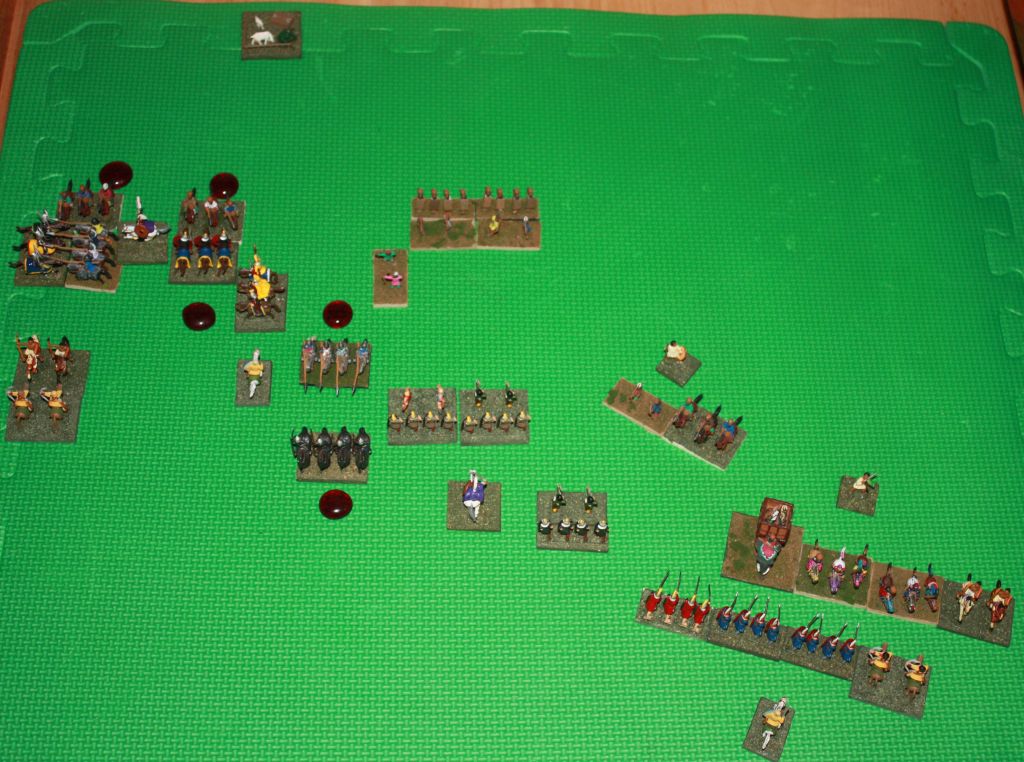
Here is a picture:

 Deployment

I will give the Romans turn 1 initiative to simulate their getting over the river and having the slight edge on Pyrrhus for deployment.

Turn 1
Laevinus spends 4 CP (command points) to army move the Leves and heavy infantry.  Army move is a group move where 2CP can be spent on a group to move the same.  DETs must be in contact, cannot enter melee but there is no limit to the number of DETs in a group.
 
Epirot centre general moves up the two skirmishers (the overall army commander is the leader and had 4 command points, others commanders are generals and only have 3.  The pike line is in range of the other general and so I''ll move them when activating that general).

Roman left general moves up heavy cavalry and also the general (general moves last in activation) moves to a more central position so is in range to be able to activate centre units as well.

Pyrrhus moves up the Agema and the Elephant and moves them together.  There are only three movement rates in Wars Ancient - Infantry move 2MU, cavalry, elephants etc move 4MU, Artillery move 1MU.  Simple.  Oblique forwards movement within 90 degrees, with no facing change, is allowed, which is how the elephant lined up with the Agema.  He also army moves the pike block.
 
The right Roman general moves the light infantry and light cavalry.  The left Epirot leader does the same (with the Epirot light infantry and cavalry).

End of turn 1
 

Turn 2
No missile fire.
Romans win the initiative.  This turn was just a moving up of all the troops straight ahead - no real manoeuvring.  The only highlight is that the Agema and Elephant are within 4", and therefore charge range, of the Roman Heavy cavalry.  The side winning initiative will have an advantage as a straight charge by cavalry gives them +2 to CV.

No melee.

End of Turn 2

Turn 3
Missile Fire (simultaneous)
I like the simplicity of missile fire resolution in Wars Ancient - Bows are range 3 and hit on a 5-6, Javelins are range 1 inch and hit on a 6.  Psiloi and troops in cover are hit on a 6 only.  Only one hit per missile phase.  No other modifiers etc.  That is basically it.  The subtleties come in other parts - units in melee can still shoot, and unmoving missile units can be given a command to fire at moving enemies unit.
 
The only missile hit was a Leves by the Epirot Psiloi bowmen. The Leves undertake a morale check and roll a 10 - they rout (turn 180 and move 3).
 
Activation
Epirot move first and Pyrrhus charges the Agema and elephant into the opposing cavalry. And also 3 units closest to him of the battleline (possibly an outline of a plan to split the battleline into two parts to better take on the Legionaries).

Melee:
Agema is 7 (has +2 for charging and +1 for armour) Vs Cavalry of 4.  Rolls 2d6 and  gets "Defender Retreats" (they retreat 1MU).  Agema must pursue.
Elephant is 5 Vs 4.  rolls 2d6 and gets "defender hit".  Elephants force a -2 morale modifier to enemies.   Heavy Cavalry check of a 3 (remember I have reduced all values by 2), which is a modified 1.  They fail, no surprise, and take 1 point of morale damage and retreat 1MU.  Elephants must pursue.  Note I rolled an 8 - heavy cavalry would have failed morale check anyway.
Pyrrhus moves (leader moves last in activation) and attaches to the Agema (to give it +1 in melee, which will mean it has double the combat value of the opposing cavalry, and will roll 3d6 for hit chance).

Left Roman General activates and is not going to tempt fate by trying to melee with the Heavy Cavalry.  He is in range of the Triarii, and starts to more them towards the left side of the table. to protect the left flank.

Middle Epirot General moves up the remaining pike block (I am thinking that keeping the battleline together is actually a good thing).
 
Laevinus moves up the skirmishers slightly and also the battleline.

Otherwise,the other flank sees the Romans move up the Light Infantry.

End of Turn 3

VP count
Epirot: 2
Roman:0

Turn 4
Missile Fire
No hits

Activation
Romans win initiative.
Left general moves the Triarii and then moves to within 2MU of the cavalry in melee.  Why? Because a general can spend one unsaved command point to a unit in melee to increase CV or Morale by 1.  This will be handy to stop Pyrrhus getting 2:1 odds.
 
Pyrrhus attacks with attached Agema - it is 6 (4 cavalry +1 armour +1 leader - oops forgot that it not longer counts as charging so no +2 for charge) Vs 5 (4 cavalry +1 added to by roman general).  Still 2d6 though and Defender takes one hit, fails morale check and retreats 1MU.  Agema pursue.
Elephant attacks - 5 Vs 4. 2d6.  Defender takes 1 hit, fails morale check and is destroyed.  Elephant will pursue 1MU.

Pyrrhus moves away from the unit to help with the main battle line combat that is coming....

Right Roman general moves up the light infantry and light cavalry, and stops the Leves rout (takes 1 command point and the Leves about faces and can be activated next turn).

Right Epirot general activates the Psiloi bowman and retreats through the pikes. Psiloi can interpenetrate other units, but other units cannot interpenetrate Psiloi.    It then activates 2 pikemen and moves them into contact with a Leves unit.

The pikes charges the Leves.  Yellow shields are the Hypaspists, bow unit can be seen at the back.

Melee: Hypaspist is MAX CV, so rolls 2d6 for potential hits. Defender 1 hit but passes morale check.  No effect.

Laevinus moves a Hastati to behind to Leves in melee (for moral support) and also moves another Hastati up to melee the pike unit.  The two Leves on the left of the battleline are moves behind the battle line, and the two remaining Hastati are moved up, one contacting the Slinger.  Note: While writing this up I realised this is 6 command points, leaders only have 4.  My mistake - leader can do 4 commands within 6MU not 6 commands within 4MU.  I did this correctly everywhere else.  Must have been late.
 
The Romans battleline advances

Melee: Hastati Vs Pike.  1d6 only (see comment at the start of the post that gives the Hastati 1d6, rather than 1d6 but repulse best result).  Rolled a 4 but as Legionaries have Wall of Shields, this is no effect.
Melee: Hastati Vs Slinger.  5 (4 Blade +1 for flanker) Vs 2.  3d6.  Defender takes a hit and routs.  Hastati do not pursue.

Centre Epirot general stops the rout (1CP), and moves the 2 pikes and Hoplite units to melee with the Hastati.

 The other battleline meets
 
1st Pike Vs Legionaries: Pike has Max CV.  2d6. Defender takes 1 hit, fails morale check, 1 damage and retreats 1MU. Pike does not pursue.
2nd Pike Vs Legionaries: Pike has Max CV.  2d6.  Defender takes a hit and passes morale check.  No effect.
 
VP count
Epirot: 6
Roman: 1

An interesting turn.  And turn 5 will likely just be as fun.

Overview at end of turn 4. 
 
Turn 5
Missile fire

Only one firing unit has a target - a Leves in contact with the Hypaspists.  No effect. Missile armed units can fire if in melee.

Activation
Romans win initiative and Laevinus  moves a Leves behind some Hastati (Psiloi give +1 CV to DETs in contact), Moves a Psiloi towards the right flank (maybe can get an advantage there) and army moves the Triarii up.  They will likely not get anywhere useful in time.  Should have moved them from the start. Does not initiate any combats with the Pikes.

Pyrrhus activates Agema for melee, and adds a +1CV.  Turns the elephant, turns the Hoplites into the flank of a Hastati, and moves a pike up to contact the Hastati.  All for 4 activations within 6".  Pretty good.
 

Pyrrhus commanding the left flank
 
Melees:
Agema is 6 Vs 4 or 3d6. Defender takes one hit and passes subsequent morale check.
Pike Vs Damaged Hastati is 2d6 (pikes have a greater CV). Defender takes one hit and fails morale check (note they would have passed without my house rule of -2 off all morale values).   Destroyed.  Pike do not pursue a destroyed unit (but do a routing or retreating one.
Pike Vs undamaged Hastati (the one with the Hoplites on the flank). Pikes have greater CV so roll 2d6.  Defender hit and fails morale check - 1 damage point and retreats.  Pikes pursue.  Note that if a unit is attacked by both a frontal unit and has a unit in the flank, only one unit attacks but there is a -1CV and -1MV for being flanked.

Left Roman general add one +1CV to cavalry and activates the cavalry to attack.   This is a 5 to 5 attack or 1d6.  Rolls a 1 - worst result possible, attacker takes a hit and fails morale check and is destroyed. Well, at least it free up the general to help focus on the centre battle.

Centre Epirot general turns skirmisher 180 and activates 2 pikemen for melee.

Melee:
Hypaspists Vs Leves: 2d6, defender takes 1 hit, fails morale check and retreats though Hastati behind.  Hypaspists pursue into Hastati. 2d6, a hit, fails morale check.

Right Roman general activates the light cavalry and light infantry to missile fire if any unit moves into range.
Left Epirot general moves the bow skirmisher a bit to the left.

VP count
Epirot: 13
Roman: 1

Overview at end of turn 5

Turn 6
I think this turn will see Pyrrhus win - he only needs 2 more VPs.
 
Missile Fire
A few misses but the Epirot skirmisher with bow inflicts 1 damage point on the Roman light infantry.

Activation
Epirot wins initiative.  Activates Pyrrhus and charges elephant into a Triarii, moves two pikes into a Hastati and Psiloi, and rotates the Hoplites.

Pyrrhus charges the troops in (phone pic while camera recharging)

Elephants melee: Elephants CV5; Triarii are 5 +1 for neighbour (Spears get +1CV bonus for friendly spear on flanks) which is 6.  Oops.  Elephants are a less CV.  Rolled 1d6 for no effect.
Pikes with Hastati melee: Pikes are 2d6. no effect.
Pike and Psiloi melee: Pikes are 2d6. Defender retreats.

Well, it would have been nice if these type of results occurred a little earlier and so give the Romans a better chance.

Romans activate left general and activates the Triarii for melee and also add 1CV to it and moves the Triarii into the flank of the elephant.

Triarii melee.  Elephant at 4CV (flanked).  Triarii at 6.  2d6. Arrgghhh.  Defender retreats.  Elephant pursues.


Centre Epirot general activated and moves up pike into contact, activates Hypaspists for melee.

Pike melee results in Hastati taking a hit and is destroyed.
Hypaspists melee has no effect  - rolled two 4s, and a 4 is ignored by DETs with Wall of Shields ability, which the Hastati have.
 
I won't do anything with the remaining generals as Epirot has reached victory, and the Romans would be unable to get enough VP to even get close to equaling the score.


VP count
Epirot: 16
Roman: 1

End of game overview


Verdict
Still a great game system.  On the modifications, the lower morale did allow for a few more damage points than would have occurred.  On the multiple hits per melee phase - this never was possible in this game.  It can happen when one general activates a DET for melee and there is a hit; later in the turn another general activates a different DET and charges into melee and so there is a possibility of another hit.  Never seemed to get the chance to do this for Heraclea.  But I think the game was faster than the previous game.  So, at least for Heraclea, it played in about an hour.  Unmodified, it may have been 10-15mins longer.  The Epirots did have the better luck in the game but the biggest issue in the game was the Romans did not wait for the Triarii to come up and help. I underestimated the power of the Pike DETs  It would be better for the Romans to hang back and let the fact they have more battleline DETs than the Epirots and flank them - either flank would work - either the Hoplites for the right flank with the light units are vulnerable. Flanked Pike DETs are victims.  Possibly aim for the Hoplite flank to help protect from the inevitable Agema and Elephant flankers (once they have dealt with the Roman cavalry).
  
Anyway, the game worked and I enjoyed it.  Will play again.

Friday, 24 June 2011

Wars Ancient rules clarifications

Background
As mentioned in the Wars Ancient battle report, I submitted some questions to the author.  Mario Magni kindly answered my multitude of questions, mostly clarifications.  I have edited them to remove my comments but otherwise are the same as the response I received.  I have not included errata from the Wars Ancient FAQ (English version).  Note that the Italian version of the FAQ page has a couple more answers.

Clarifications
 
Question
p17 Combat:  How do units already in contact start a melee? Does a DET have to be activated to melee with another unit it is already  in contact with?

Answer
Detachments when activated before they are moved, when all DETS have moved from the general, if they are in contact with a enemy detachment, fighting. If the fight does not have a winner, the two detachments remain in contact and we can not disengage. In the next round a player can activate a general and assign a command point to activate the detachment in melee, re-roll the dice to try to resolve the melee. Important only activated detachment can roll the dice. The detachments will remain in contact until the players will not solve the melee.

Question
p19 8.4.1 Morale additional rules
This states that a DET can only sustain one Morale damage per game phase. Just to clarify, there are only 3 game phases:
Missile
Initiative
Activations (in alternating general sequence)
So, a DET can receive 1 morale damage at most in missile fire and one m orale damage at most during the activations? Or by game phase did it mean per each general activation phase?

Answer
Yes, a detachment can take only 1 damage for phase, so it can only receive 1 damage during the shooting and only 1 damage in the activation phase.

Question
Section 3.0 mentions that DETs are placed within 5MU from our side of the table. Does this mean there is no limit to how close to the side of the table a DETs can be deployed?

Answer
Yes part of your side of the table up to 5 MU, within this rectangle can deploy your army.

Question
Section 4.2..2 second paragraph (top of page 12). Can a missile unit can fire on an enemy DET if it is in contact and if in line of sight? If it can fire on a unit it is in contact with, then a javelin unit could fire on a unit contacting it in the flank or rear as it has a 360 degree fire arc.
 
Answer
A DET engaged in melee with the ability Missile can shoot at the sole DET which is in contact on the front. If that DET has the ability to short range can shoot a DET which engages the sides or rear.

Question
Section 4.2.3 readying missile fire. It says a ranged weapon DET can "readying to fire" if it does not move. If it fired, can it be "readying to fire"?

Answer
This is an order that a general can make spending a command point. The order says that a DET with the ability missile can prepare (put a counter near the DET) firing during the movement of his opponent. This order remains until that DET is not activated yet, or pulls a DET enemy.

Question
Section 6.1 DET and command points says only a single command point can be spent on a DET. But in 6.3, a command point can be given to a DET (once per game turn) for a bonus in combat. As a CP has to be spent to activate the unit, and another spent to give it a bonus, is 6.3 an exception to 6.1 only having one CP per DET per turn?

Answer
Yes. A DET can be activated only once every turn. If a general decides to keep some control points, before you can roll the dice for a melee to give the same that triggered DET (using another point did not use that command to activate DETs) a bonus of +1 MV or +1 to CV.

Question
Section 7.1 Movement. What does "taking place within 90 degrees from the centre of the unit base" mean? Can a unit move forwards, maintain it facing but move a bit to the left and right?

Answer
Yes

Question
Section 7.1 Movement. Can a unit move straight ahead and turn in the same game turn? I assume they can as nothing prohibits it, and the replay diagrams on the website seem to show you can.

Answer
Yes

Question
Section 7.2 Turning. Most unit bases are 6cm wide and an MU is 4cm. For a DET to be able to move 90 degrees it will need to move about 9cm. This means the 2MU units (infantry) cannot do a 90 degree turn in one game turn. I then note in 7.3 Battle maneuvering, under the dot point "rotation 90 degrees", that a DET can rotate to change facing and if done twice it is an about turn. I realise this is a very different maneuver to a turn - it rotating on the unit base , not a turn.
a) is it correct that a turn of 90 degrees is not possible to 2MU units?
b) if the cost of an about turn is all of a DET's MU, what is the cost of changing facing (rotation) by only 90 degrees - half the DET's MU?

Answer
There is a FAQ on the site, which says that a rotation of 90° DET spending 1 MU of movement, then a DET can rotate 90 degrees and move to a 1 MU.

Question
Section 8.2 Combat Ratio. If the active DET combat value is less, the best possible result is repulsed. What are these results?

Answer
DET (A) CV 3 attack DET (B) CV 4
dice results and effect:
--1--  (A) check morale if wrong take 1 hit.
--2-- (A) retreats
--3-- (B) retreats
--4-- (A) e (B) check morale if (B) wrong retreats, if (A) wrong take 1 hit.
--5-- (B) check morale if wrong, retreats
--6-- (B) retreats

Question
Section 8.2.1 states that DET in SWAMP suffer -1 to morale and some DET types cannot cross. Section 10 states that a SWAMP is impassable (and section 8.5 has a diagram showing SWAMP as an example of impassable terrain. Is 8.2.1 incorrect and SWAMP is impassable?

Answer
The swamp is impassable for only certain types of DET. The example is made for a special DET as chariot or elephant, Yes, the pictures can be misunderstood..

Question
Section 8.5 Impossible retreat. If blocked, a routed/retreating DET suffers a morale damage. If it has already sustained a morale damage during melee this game phase (for example, it is retreating and so has just got a morale damage), does it receive another one and so be destroyed? 8.4.1 has that a DET can sustain only one morale damage a game turn phase.

Answer
A DET take a hit, check morale, if it wrong and flee, only 1 damage will suffer , if it can not escape because its corridor of escape is blocked, can not suffer another injury because a DET suffer 1 damage in a turn.

Question
Section 8.6.1 blocked escape route - same question as above. If the DET has already suffered damage this game phase, will it receive another morale damage and so be destroyed?

Answer
No, see above.

Question
Section Attribute list (on the back page):
a) MOUNTED. The +1 to CV - has this already been calculated into their profile?
b) FRAIL. I assume this is the same as FRAGILE that is in the WAR MACHINES description?
c) SPEARS has a attribute of LANCE. I assume this is the supposed to be the attribute SPEARS.
d) FLANKERS and FORMATION. These give bonuses when on the flank. Do they also give the bonus if the DET is to the rear of the unit and in contact?
e) COMMAND, CHARISMATIC LEADER and ORDER - these are included for leader descriptions?
f) ELUSIVE is a list attribute but not an attribute for any DETs.
g) MOB state it is an irregular infantry formation not suffering flanking negative effects. Does this mean MOB acts like the FORMATION attribute, but flanking MOB DETs will add +1 CV regardless of if they are in contact with enemy units?
 
Answer
a) YES
b) YES
c) YES
d) YES
e) YES
f) No. It is in the FAQ - Elusive is a BOWMEN's ability.
g) MOB have +1 MV in contact.

Question
The DET list on back page and also the army cards. BOWMEN has a CV of 3 (6) and WAR MACHINES a CV of 2 (8). What are the values in parentheses - the (6) and the (8)?

Answer
They are values that I added to the optional rules that will come out.
 
Question
When a unit routs, can the attacking DET pursue? The rules state (section 8.6) a retreating unit has the attacking DET pursue (if it wishes or has to if impetuous). Is a routing unit treated as retreating? A retreat is only 1MU but a routing cavalry moves 5MU so would an attacking infantry pursue and remain in contact?

Answer
A detachment can pursue another detachment of the enemy only 1 MU.
 
Question
Can a DET move away from an enemy it is on contact with?

Answer
NO!

Friday, 24 December 2010

Wars Ancient rules overview and battle report - Persians Vs Romans

Background
I am ongoing quest for fast play ancient rules that play on a small table.  I am supposed to be refighting Zama with numerous rules, but got sidetracked by doing a battle report when Rally Round the King was released.  I have been sidetracked again.  I saw on a thread on TMP that the Irregular Miniatures are carrying a new ruleset - Wars Ancient.  There is a website for the game and also a boardgamegeek entry.  But that is it.  The rules are not cheap (22GDP), and shipping from the UK to Australia does nothing to help keep the cost down.  But they sounded interesting - and they are interesting.  Shiny new rules are a distraction.   So following is an overview of the rules and a battle report between Sassanid Persians and Eastern Romans (yes, I know I did that for Rally Round the King too - it was easier for me as I had the armies still out).  Battle report won't be as detailed as I normally do (might do when I use them for Zama) but enough to try and convey a feel for the rules.

Overview of the rules
This is not really a full review - more an overview of the rule mechanisms and some comments based on a playing.
 
Forces
Unit bases are mostly 6cm frontage by 3cm depth.
A unit is one base and called a DET (Detachment).
An army is initially 15 units split across 3 commands - a leader-general with 5 units and 2 generals each with 5 units.
 
An army also get six strategy cards - more on these later.  Strategy cards are an important part of the game - they provide terrain, additional unit capabilities and tactics that can be implemented during play.

Movement is in MU which is 40cm or 1.5 inches.
Table size is 40" by 32".
Moves are 2MU for infantry, 4MU for mounted.
 
Units can move straight ahead, wheel, about face and a few special moves such as swap places.
The terminology for units are similar to that in DBA - Psiloi, Auxilia, Blades, Light Horse etc but besides combat values being similar the only resemblance to DBA is the unit names.
 
Troop types are differentiated by having a Combat Value (CV), a Morale Value (MV) and some attributes (about 3 is average) from a list of 20 or so.
 
Attribute examples:
Fierce - +1 CV if attacking (warbands have this)
Charge - CV bonus (cavalry have this)
Formation - +1 CV for friendly unit in contact (heavy infantry get this)
Impetuous - units must follow up in rout (cavalry, warbands).
Short Range - short range missile fire.
 
All units have two "Morale Damage" points.  If a second morale damage point is received (i.e. they fail a morale check twice) they are destroyed.  However, a unit can only receive a limited amount of morale damage per turn (see later as this is important but need to describe the other concepts first).
 
Deployment
Strategy cards (see later) are used to alternatively place any terrain.
Then players alternative deploying a camp.
Then players alternative deploying one command (general + 5 units) at a time.
There is an optional scouting rule where the scouting value of a side is determined and this can effect unit deployment.
There are simple weather rules.
  
Turn Sequence
1. missile fire - simultaneous
2. initiative - roll 1d10 and highest determines who goes first
3. players turn:
   a) First player activate a general and move/melee units in command range
   b) Other player activates a general and moves/melee units in command range
  c) Alternate until all generals activated.
4. count Victory Points.
 
Command and Control
A leader/general must spend a command point to activate a unit to move.  Unit must be in range.  Unit can be activated only once per turn.
Leader-generals have a command radius of 6MU and 4 command points.
Generals have a command radius of 4MU and 3 command points.
Leaders/Generals have unlimited movement.
 
Missile fire
Missile fire is simple.
Bow fire is 3MU - d6 roll, hit on a 5-6.
javelin fire is 1MU - d6 roll, hit on a 6.
In cover - only a 6 is a hit.
 
A missile unit that doesn't move may be placed into "opportunity fire", where it can fire during the player turn.  Missile units may fire at enemy units in contact and in firing arc.
See what a hit means under melee. 
 

Melee
Melee is where it gets interesting. Bases line up edge on edge (like DBA) for combat.  There is a shuffle when units engage to ensure this happens.
Combat values of opposing units are compared.  The unit that is active rolls 1 to 3 d6 depending on the comparison ratio - The higher the CV ratio, the more dice rolled.
 
Each pip of a d6 has a specific result ranging from attacker takes a hit (a '1') to defender takes a hit and retreats (a '6').   For multiple dice rolls, the attacker chooses the best result. So, the more rolls, the more chance of choosing a bad thing for the defender. Nice.
 
The base combat values for a unit can get modified by attributes and attached generals.

A hit is not really a hit - A hit is a morale check.  Every time a unit is hit, roll a 1d10 and compare against the morale value: if less, pass; nothing.  If more, take one morale damage.  Two morale damages and the unit is destroyed.  On a natural 10, the unit routs which is a an about face and a full rout move back towards your table edge.  Routing units can be rallied using a command point.  I like this.

Morale values also can get modified by attributes, and +1 for each unit in contact.

A unit cannot take more than one morale damage point in the melee phase or the missile phase.  Units hang around for a while.
 
Strategy Cards
Things come into their own with Strategy cards.  There are 32 of them.  Players get 6 each. Historical lists get about 4 defined and 2 random.  Strategy cards range from terrain, deployment options to tactics during the game.

Terrain is placed if a player plays the appropriate terrain strategy card.  It is placed anywhere.

Deployment options (and some of these can be played during the game) are such things like:
  • replace up to 2 Auxilia with Bowmen
  • the enemy leader is ill - reduce his command value by 1
  • Replace an Auxilia with a blade or spear unit.
  • Increase the morale value of a unit by 1. 
  • After all deployment, redeploy 2 units.
Strategies that can be played during the game are:
  • Fanatics - select a unit and morale is now 9.
  • Select an Auxilia - it is now a heavy infantry unit;
  • Select a unit to now have javelins.
  • Treason - and enemy unit is now on your side.
  • My favourite is select up to 2 Auxilia and change them to Bowmen.  I am not sure of the reasoning behind that one!
The strategies cards are not balanced but getting 6 of them each would reduce imbalances in their effects.  I don't think I would play with some of the cards - they just seem a bit weird.  But the cards add some uncertainty to the game and should make it quite interesting.
 
Army Lists
There are 10 army lists given but the game is designed for more build you own armies.
There are no points values for units.
Building armies consists of an Auxilia plus 4 random units and 10 selected units.  Note there are minimum and maximums for unit types.
 
That being said, I think the game will play quite well with historical armies.  My first replay was using a historical army list generated from other sources.
 
Determining the Winner
Victory points are awarded for inflicting morale damage, destroying enemy units, sacking an enemy camp and destroying enemy generals.  First side to reach 15 points wins.
 
Presentation
The rules are clear and the layout is fine. The rules total 24 pages including army lists, optional rules and pictures of games in progress.  There are diagrams littered throughout the book to assist in describing some mechanisms.   The Strategy Cards and Army cards are in the book and need to be cut out.  I used a paper guillotine.

The only issue I really came across is that attributes and their effects are in one table on the back of the book.  The effects are very important and listed no where else.  Such things like Skirmishers reduce attacking infantry CV by 1 and Mounted destroying routing Psiloi and Bowmen. These effects are not referred to anywhere else in the rule book (not even an indication that unit attributes are varied and have a large effect on unit interactions) so when you get to the back page, the richness of the attributes for the units takes you by surprise.

I had only a couple of questions and clarifications I sent to the author which I will post once tidied up. 

My verdict on the rules after a battle are at the end of the post.  But in summary: not for everyone,  I liked them a lot, will play again and lends itself to tweaking (using the existing rule mechanisms) to get your version of history.

Back to the battle report....
 
Troops
There is no list for the Sassanid Persians and Later Eastern Romans.  Armies are 15 DETs each so I just used the first edition Armati lists as a basis (they are about 15 units each).  As I mentioned earlier, the rules lend themselves to historical tweaking - you could adjust combat and morale values to better differentiate troop types. But I will resist for this replay and stick to the standard troop types.

Sassanid Persian
2 Cataphracts
4 Cavalry (one has +1 CV +1 MV due to Weapon Maker Strategy Card)
2 Light Horse
2 Auxilia
4 Psiloi
1 Elephant
+1 additional Cavalry from playing a Strategy card.

Later Eastern Roman
1 Cataphract
3 Cavalry
2 Light Horse
3 Blades (+1 MV and Wall of Shields due to Legionaries strategy card)
3 Auxilia
3 Skirmishers

Strategy Cards

Cataphracts is a Strategy card.  There is only one, but I could not help but give the armies the cataphracts I think they deserved.  So I will reduce the number of Strategy cards by 2 for the Persians, and by 1 for the Romans.  Further, I will give 2 Missile Weapons to the Persians. And 2 Thrown Weapons and 1 Legionaries (I chose to only apply this to the Blades) to the Romans.
This leaves 2 random cards for the Persians:
  • Weapon Maker (used in deployment - one DET gains +1 to CV and MV)
  • Mercenaries  (deployment - add one Spear, Bowman or Cavalry last). 

And 2 random cards for the Romans:
  • Treason - play at start of a melee and enemy DET becomes yours.
  • Strategist  - either redeploy army at end of deployment or redeploy 3 DETs during play.
Deployment
If you use 4cm width bases, that is 2/3rds of the recommended size, and then a MU needs to be reduced by 1/3rd which equal 1" and table size goes down to 22"x28" which is close to 24"x24".  Eminently playable.   And I only have units based on 4cm wide bases.  I don't have a 2x2 board except a (slightly bright) green 26"x26"mat I picked up from a hardware store.  I'll use that as my real 2'x2' board is being used for Zama refight.  I'll deploy 2" further in to account for the slightly wider board.

Normally alternate deployment, but will skip this as solo and can't outthink myself this late at night.

Deployment view from the Roman side

Romans setup cavalry on the left flank, legionaries in the centre with skirmishers and auxilia on the right with a light cavalry.  Leader is in the centre. 
Roman plan - break the left flank, maybe using some blades from the centre.  Hold or break the centre. Panic at the large force on the right flank so refuse it.

Persians setup General with cataphracts and heavy cavalry on their right flank, levies with some skirmishers in the centre and more heavy cavalry and the elephant on the left flank.
Persian plan - use the cavalry on the wings to beat the Romans.  Hold the Romans on their left flank with equivalent forces and hopefully break their right flank.  the centre is weak, but only has to hold - may not even need to engage.

Turn 1
A general advance by both sides.  Shuffled some Psiloi when I reread their atrribute of providing +1 to a DET on their flank.  Cavalry get +2 to their CV if they charge so initiative is important - The Persians only moved up the Cavalry within charge distance of the Roman left flank - the Cataphracts advanced but not to within charge reach.


Roman left flank

Turn 2
Romans win initiative and charge into 2 of the opposing cavalry and cause a rout.  The Persians retaliate and cause a damage point as well.  The cavalry on this flank is becoming a bit of a swirling mess.

Roman left flank and centre area

I'm using blood red glass beads for damage markers.  Seemed like a good idea at the time but blood red on bright green does clash.  I will go back to casualty rings next game.


Elsewhere, the Roman centre advanced and the Persian left flank continued its advance.

Roman right flank

Victory Points: Persian 1 Roman 1

Turn 3
Romans charge in on their left flank and cause 2 damage points. The Persians retaliate and cause a cataphract rout and some damage elsewhere.  The rest of the board is taken up with an advance on the Persian left flank to within 1MU of the Romans.  In hindsight, maybe the Romans should have really used the treason card on the Cataphract melee, but I have been saving it for the Roman right flank, where they could get overwhelmed.  The Romans also have the Strategist card, which I was going to use to redeploy some centre legionaries to the left flank, but a pursuit by a Persian cavalry has quashed that idea - The Strategist card only allows redeployment is no enemy are within 4MU and the pursurer is now within 4MU.

Roman side at the bottom of the picture, Persians at the top.


Victory Points: Persian 2 Roman 3

Turn 4
Missile fire - the Persians play the 2 missile weapons cards to give missile fire to 2 cavalry on their left flank.  Roll to hit - both miss.  
Romans win initiative for the 4th time (!).
The chaos on the flank with the cavalry on cavalry continues.  The centre legionaries split up to start the journey of being assistance to the other flanks.

Legionaries split

The Persians cavalry and elephant charge into the Auxilia.  The Romans play the Treason card and turn the Elephants.


The treasonous elephant

Otherwise, the charge was disappointing - only one damage out of three attacks.  And cavalry get +2 to their combat value when charging.

The Roman right flank after they turned the elephant


Victory Points: Persians 4 Romans 3

Turn 5
Persians finally win initiative.  In the cavalry swirl, a roman cavalry succumbs to the general and cataphract and another flanking cavalry.  The Persians activated quite a few melees and the dice were hot - scoring morale checks in almost all of them and inflicting some damage.  The flanked Light Horse on the far right of the Roman line was destroyed.   The Romans did not have much go there way but the Elephant (now Roman) assisted in causing damage to a neighbouring - former friendly - cavalry.

Overview with Romans at the bottom.

Victory Points: Persian 10 Roman 4

Turn 6
Persians win initiative for the first time.  The Roman camp is three moves away from the cavalry on the right flank.

The Roman camp is only an about face and two moves from the Persian cavalry to the left.

It is probably worth giving it a go as capturing the camp would give enough victory points to win the game.  So the cavalry move towards the camp. There was little movement this turn - more jockeying for position, a bit of flanking and an advance of the Roman centre.  No hits this turn - everyone survived any morale checks.

Turn 7
Still no hits from missile fire anywhere!
Things are slowing down as most units are in melee, or don't want to be so don't move!  The Persians are only one move from the camp.  The Romans finally managed to destroy the Persian cavalry flanked by the elephant.  And also finally destroyed the Persian cataphract facing the Roman cataphract and flanked by a legionary unit.

Overview - Romans to the bottom, Nadia the dice roller at the top.  Having the game in a drawer helps protect it for the weeks it takes to play.

Victory Points: Persians 10 Romans 8

Turn 8
The Persians win initiative and attack the camp, successfully scoring a hit which means it is captured.  The Romans lost a melee against some Persians cavalry: they rolled two 1's on the dice roll to hit, which means the attacker needs to do a morale check, which they failed.  They already had a melee damage and were destroyed.  Those snake-eyes rolls are bad - this was the second one for the attack (last time the attacker passed the morale check).
The Romans give up as there is no way they can exceed the Persians victory point score this turn, and most places they could try, there is just as much chance of worsening their victory point score!
Victory to the Persians.
Final victory points: Persians 17 Romans: 8

Final positions

Postscript to game
There were a few rules I did not play correctly.  When I started the game, I sent off a few (ok, about 14 and I do feel bad about asking so many at once) clarification questions.  They were not really omissions, just things that seemed unclear.  There was only about 3 things I think I had assumed incorrectly.  An example of one of these is that units that have missile fire capability can fire at enemy unit in contact with them to the front (it does imply this in the rules so my bad).  I will format the clarifications and post them here later.


Verdict
I like the rules.  I was thinking they could be used for fast play, but they are aimed at the 2-2.5 hour game.  It should be obvious, as it is written in large letters on the front of the rule book: 2-3 hours.  But, again, I was thinking, maybe they could be cut down, as per some of the other rules I have tried.  Probably not - I may do some more thinking on it before using them for a Zama replay.  Anyway, the rules may seen to be simple, but they are not simplistic.  The command and control system is excellent, and the grind of melee is well represented.  Troops have both a combat value and morale value which works well in differentiating the units.  Lastly, a word on the cards - while they could be powerful, they are not within the mechanics of the game.  And they do add uncertainty to the battle.  The game can be used for straight pickup games with selected forces but would work quite well for historical games and historical scenarios.