I played the first scenario from the strategic level ancient boardgame – Imperator. I played out the 12 land battles that arose using some new rules of my own making on a 8x8 grid that use the same units from Imperator. These are also the same units in the Bill Banks’ Ancients boardgame.
Sieges, and there were a few!, are resolved using the method in the rules - dice rolling for losses until defenders eliminated or attacker calls off the siege.
This post contains the scenario report and also a brief report of all the battles that took place.
The reading of this is a little dry but skimming the post should give you an idea of how the campaign played out.
Background
Imperator
So there I was happily playing through the scenarios of the boardgame Fall Of Rome after finishing off a 20-years-in-the-making side project (a viable WW2 game on a 3x4 grid). Caliban commented on the Fall of Rome game blog post that it would make a good campaign generator for miniature battles. It doesn’t but that triggered off the fact I acquired the boardgame Imperator in 2012 as it is by the same author of the Ancients boardgame – Bill Banks – and it is designed with the option to play out the battles using the Ancients game. My own rules - Ancient Battlelines Clash - are loosely derived from Ancients (amongst some others) and so I had acquired Imperator planning to play it and then the battles using my own rules. But I got side-tracked into other projects. I had never actually heard of Imperator until 2012, which is surprising as I got the Bill Banks Ancients game back in the early 90’s and I would have jumped at obtaining a campaign version. There is no review of Imperator but the description at boardgamegeek is a good starting point.
 |
| Imperator - ancients operational gaming |
 |
| Ancient - mass ancient battles |
Instead of using Ancients, or the quick combat resolution in the game, I created some new rules to play on a 8x8 grid. Now this is another 20 year project in the making. When I got Bill Banks Ancients, I liked it as a game, but not so much as a “matches my view of history” game. So I wrote some rules combining Ancients with Armati, that were not great and did a few rewrites over the years, trying to turn the Ancients into a more palatable set of rules. I had a go in 2011, called Fast Ancient Battles and they were OK but not great (there are soe games with it on this blog somewhere). I continued on with the other ruleset I was also writing at the time – Ancients Battlelines Clash – that are a derivative of Ancients, Rally round the Kink, Justified Ancients and Armati. These rules are fairly well done as of 2016 and one of the main reasons I have not really played Imperator as I was loathe to create a revised fast play set based on Bill Banks Ancients unit types as I may give up on Ancients Battlelines Clash and move forwards with these rules instead (can you say wargames rules butterfly?). What I did was keep the Bill Banks Ancients troop type (as they are heavily linked into the operational side of Imperator) and then streamlined the Ancient Battlelines Clash Rules to fit these troop classifications and fit on a 8x8 grid. Why a grid? I have some 6mm figures I bought a couple of years ago and have not yet used them – using a, 8x8 grid on a A4 sheet of paper I do not have to base them and can leave them on their metal strips (The plan was always to make the game portable with 6mm figures) Why 8x8? It just seems right. Why a grid and not hexes or offset squares? Playing hexes I feel like it is a boardgame and for some reason I feel that less so when playing with squares. I still do play hex based boardgames, and more recent square based ones. Offset squares give me the same feeling as hexes. I may get over this whole hexes/squares/grids Vs open table as I get older. But the grid seems to work. The rules survived the 12 battles with very little modification, but then it was not challenged with many of the troop types.
I still need to tidy up the rules but will do so soon-ish and then put them up on the blog.
Miniatures
I got some 6mm ancient figures off ebay a few years ago. All still on strips, some painted, some undercoated, some bare metal. They are mostly for Alexander the Great battles - Macedonians, Persians, Indians but with a few barbarians thrown in. At 6mm, the Persians can stand in for Middle Eastern armies. I don't assign specific strips to each force and just use what is available for both sides. I am playing that LI are close order infantry and so use close order infantry for them - anything with more than 4 figures on an strip. MM are peltsts and so 3- or 4 figures on a strip; LA are skirmishers and use 2 figures to a strips. Chariots are not light or heavy so will use 4 horse chariots on one side and 2 horse chariots on the othr so I know what side they belong to. Leaders are single figures or cavalry bases.
Bringing it all together
I found the beginnings of a spreadsheet I had done in 2012 for Imperator to assist with the random events and to keep track of things. I cleaned it up and added in missing bits. This really helped in generating events and keeping track of treasuries, ownership, income, victory points and events outcomes.
My map drawers, within which 95% of my gaming occurs, will not fit the Imperator map so I quickly did up a PowerPoint stylised map of each half of the map – each an A4. The first scenario only needs the eastern side so only 1 A4 required. There are not a lot of counters required to be on the map anyway so this should work (spoiler: it worked fine, although it did feel a little cramped – if I play another scenario I would blow it up to A3).
 |
| The Imperator map - a standard 22"x34" size |
 |
| My A4 conversion of the left hand part of the map. I tried to make it align to an underlying map, but that was not going to work on the A4 page. |
 |
| My setup in the map drawer, from left to right - QRS, battle board, map and forces |
And what I thought would happen has happened and I want to make When Warriors Collide to work on a 2’x2’ table and take the easy way and just use a 12x12 grid with each square being 2", easily fitting DBM 15mm figures with 40mm wide bases. Grids just nake the game fit together so much easier without needing fiddly rules for open movement. I always knew this but it seems as I get older, it becomes less of an issue to use grids, and can focus on the game itself. I did not have do do much other than change the terrain generation rules and tidy up some of the grammar. I hope to test out the rules with a few historical battles before the end of the year. .
Bill mentions to feel free to change things, so I have. Scenario 1 s a learning scenario and all the forces are very similar so I have changed the composition of the armies a little and given them a larger force pool and a slightly bigger Treasury makeup. I have also slightly changed forces for minor countries and rebels slightly. For those that care, here is my modified scenario 1:
Hammurabi Summer 1700 BC; 4 periods
Major Countries:
1. Babylon
Treasury: 30
Force Pool: 4 traders, 2 biremes, 2 LI, 2 LA
Mesopotamia: 20+1 city, 2-2 monarch, 2 CH, 4 LI, 1 MM, 2 LA
Peace with Mitanni, War with Larsa
2. Hyksos
Treasury: 30
Force Pool: 4 traders, 3 biremes, 1 CH, 2 LI, 2 LA
Egypt: 20+1 city, 2-2 monarch, 2 CH, 3 LI, 1 MM, 1 LA
3. Hittites
Treasury: 55
Force Pool: 4 traders, 2 biremes, 2 LI, 3 LA
Anatolia: 20+1 city, 2-2 monarch, 2 CH, 3 LI, 3 LA
4. Minos
Trasury: 50
Force pool: 4 traders, 2 biremes, 2 CH, 3 LI*, 1 LA
Crete: 20+1 city, 2-2 monarch, 2 CH, 2 LI*, 2 LA
Eastern Med: 2 biremes
5. Indus Valley
Treasury: 45
Force pool: 4 traders, 3 biremes, 2 MM, 1 LI, 1 LA
India: 20+1 city, 2-2 monarch, 1 EL, 2 MM, 2 LI*, 2 LI, 2 LA
Raiders:
1 Libyans, 1 LI(!) Cyrenica
2 Nubians, 2 LI(!) 1 MM Egypt
3 Semites, 1 LI Arabia
4 Kassites, 1 LI Mesopotamia
5-6 Aryans, 2 CH 1 LI 1 LA India
Rebels:
4 LI 1MM 2 LA
Minor Countries:
Larsa: Mesopotamia, 10+0 city, 1CH, 2 LI, 1 LA
Mitanni: Mesopotamia, 10+0 city, 1 CH, 1 LI, 1 LA
Phoenicia: Syria, 2 10+0 cities, 1 CH, 2 LI, 2 LA
Cyprus: Cyprus, 2 LI
Others: 3 LI 2 LA
Note: For minor countries, I assume a raider force equal to militia force is created when invaded. The WAR event seems to indicate this but I could be interpreting it wrong but it makes for tougher battles so will play my way :-)
Game Setup
Note for events – if the random province for events ends up not being on the eastern side of the map I am going to ignore it.
The game starts with most forces in their respective
capitals. Except Babylonia. Babylonia is at war with Larsa and they will
create a Raider force equal to the militia force and go for Babylon. So I have placed Babylonia forces in the
province so they will intercept them. And it will try out the battle rules, even
if a bit one sided.
1700BC Summer
 |
| At start map. |
Summer Events
Events have nothing much, other than India obtain a 2-3 General.
Non-players move
Events have nothing much, other than India obtain a 2-3 General.
Non-players move
Larsa creates a raider force of 1CH, 2LI and 1LA and marches
to attack the Babylon army. A battle is on! I read the Imperator rules fairly carefully and it seems that the Larsa militia (1CH, 2LI, 1LA in the city) will also move to attack any army in the province and so I think both forces move together to attack. I may have misjudged making the minor countries forces larger. Babylon is facing a force nearly as large as itself!
Battle of Mesopotamia Summer 1700BC – Babylonia Vs Larsa
Babylon 20 combat points, Larsa 18. The battle is at 1:1 odds. I have a spreadsheet that assists with working out some actions and combat tactics is one of them. At 1:1, Babylonia selects Envelop Flanks, Larsa choose Refuse Flank. The units are set up on the board. I used a clear terrain table as I have not though through terrain generation yet and how to apply my system to a 8x8 grid (I did this after the first few battles so terrian does turn up in some of those).
I won’t go into the battle too much. I used a cut down version of my programed opponent.
Larsa is attacking with the right flank
The sides advance, the Babylonian chariot with a leader attacks the Larsa chariot with the leader and causes it to be disordered. First blood for the rules! Ok, I lie a little, i have actually run two games in a spreadsheet to see how they work - the first was a very simple test game, the second added in the programmed opponent for both sides. Still, it is first blood with miniatures.
The battle progresses. The rules seem to be working fine, after 2 player turns :-)
The Larsa manage to get the chariot in the flank on their left but they roll a 1 - anything else would have put the opposing leader and chariot at a huge disadvantage :-). On the Babylonian right flank, the chariot with the other leader managed to help roll up the flank. The Larsa force panics and only one chariot manages to leave the field and retreats to Larsa city. Larsa was very unlucky in this game. And also note I think Larsa should have been given 2 leaders not one Militia have a 2 command bonus. Ah well, and I remember to do this for militia armies in the future.
Babylon only lost 2 LA, one of which recovers (yes, there are rules in Imperator to recover some of the forces lost during a battle).
Babylon turn
The Babylonians now will siege the city of Larsa. I have my spreadsheet to help here too.
Siege of Larsa Summer 1700BC
Larsa has 4CP, Babylon 18.
Battle of Persia Summer 1700BC
The Events of note are:
Non-player moves
Larsa has only one chariot. In the rules, they should move out of the city to attack the much greater Babylon army. They can do more damage by staying in the city, and if they survive to Spring they come back at full strength. so I create a house rule: an army outnumbered by 3:1 or more will not move out of a city to attack a force outside. So Larsa will not move. There are no other non-players.
Babylon turn
Siege Larsa (4CP) with the army in Mespotamia (13CP). No assault, no progress in the siege.
Hyskos turn
Hyskos does nothing but purchase some units - LA are the cheapest so 2 of them and an LI (9 talents). Ready for the Minoan siege!
Hittite turn
Move trader to Syria
Purchase one research and gains Engineering (helps towards victory).
Minoan turn
Siege of Avaris Fall 1700BC
Continue siege of Avaris, Hyskos has 8CP and Minos only 9CP.
Siege falters! (i..e nothing happens).
Move the trader to the fleet in the Eastern Med.
Purchase a CH and LI to cover losses (12 talents).
Indian turn
Does nothing.
Winter 1701BC
Winter is upkeep time. And some do not have enough in Treasury to pay maintenance on the troops. I did know this was likely to happen - the next season is income, but the games starts after that. The Treasuries were not really enough to cover the troops. So what I did do was any that went negative I have increased to 0. I also have modified the scenario starting treasuries at the start of this post to reflect this.
Babylon turn
Siege of Larsa Winter 1701BC
Siege Larsa (4CP) with the army in Mespotamia (13CP). Finally! Starved them out. Larsa chariot lost and no losses to Baylon. The forces enter into Larsa. It is ours!
Hyskos turn
Hyskos has a treasury of 7 credits so buys a chariot to help defeat the Minoan siege.
Hittite turn
Do nothing (treasury is at 0)
Minoan turn
Siege of Avaris Fall 1701BC
Continue siege, which is risky as it is now Hyskos with 12CP and Mnos only 9CP.
Hyskos sorties and the Minoans lose 5 CP (a CH and LA)
Move the recently purchased CH and LI to Egypt.
Move the trader from the the fleet in the Eastern Med to Syria.
Indian turn
Does nothing.
Spring 1701BC
Spring is income time:
Babylon: +33
Hyskos: +24
Hittite: +40
Minoan: +44
India: +40
Battle of Egypt Spring 1701BC
Babylon 20 combat points, Larsa 18. The battle is at 1:1 odds. I have a spreadsheet that assists with working out some actions and combat tactics is one of them. At 1:1, Babylonia selects Envelop Flanks, Larsa choose Refuse Flank. The units are set up on the board. I used a clear terrain table as I have not though through terrain generation yet and how to apply my system to a 8x8 grid (I did this after the first few battles so terrian does turn up in some of those).
I won’t go into the battle too much. I used a cut down version of my programed opponent.
 |
| My simple programmed opponent. . Each zone (left flank, centre, right flank) has one of the orders across the top. ABC are missile armed units, s = skirmishers, CH = chariot, HA are heavy archers; g is 1 grid square |
 |
| Larsa deployment top, Babylon on the bottom |
 |
| Babylon on the left, Larsa on the right |
The battle progresses. The rules seem to be working fine, after 2 player turns :-)
 |
| Midgame. The brown blogs mark disordered units |
 |
| Endgame |
Babylon only lost 2 LA, one of which recovers (yes, there are rules in Imperator to recover some of the forces lost during a battle).
Babylon turn
The Babylonians now will siege the city of Larsa. I have my spreadsheet to help here too.
Siege of Larsa Summer 1700BC
Succesful sortie by Larsa sees Babylon loses 5CP (take it as 1LA and 2LI).
Purchase - won’t buy anything as will need the money to pay for
the troops in winter.
Hyskos turn
Hyskos is going to invade Syria. Not random, just decided –
Syria is a 15 point province and Hyskos should try and get it while Babylon is down. And also gets Hyskos close to taking on the other
major players if need be..
Unclear on the rules, but will assume that when invaded, war
starts and so a raider force is created as well in Syria. Even if I am playing
it wrong (and on reflection almost likely), I like this at is makes it harder to knock off the minor countries and gives them more forces and so a more even battle.
Battle of Syria Summer 1700BC
Hyskos (attacker) 17CP: 2 CH, 3 LI, 1 MM, 1 LA with 2-2 monarch
Hyskos (attacker) 17CP: 2 CH, 3 LI, 1 MM, 1 LA with 2-2 monarch
Phoenicia 10CP: 1 CH, 2 LI, 2 LA and 1-1 raider (the militia of 1 CH, 2 LI, 2 LA and 2-0 defending
the cities).
Note in hindsight I should have really combined the raider and militia into one force and any survivors of the battles (there would be a few) would have retreated into the cities.
Hyskos charges (both flanks and centre will charge)
Phoenicia stands (all zones hold)
Things went bad when the Hyskos lost a LI to a die roll of 6 in the centre. And then another LI to a die roll of 6 in the centre. And then the left flank chariot to a roll of a 6. Another LI saw them panic.
One more turn left and the Phoenicians rub it in by destroying a CH.
Post battle: Phoenicia: lost 2 LA; Hyskso: 2CH, 3 LI, 1LA. Hyskos have 1 LA and 1 MM left and retreat back to Egypt.
Purchases: Hmm...should buy a few troops back...a CH will do (7 talents).
Note in hindsight I should have really combined the raider and militia into one force and any survivors of the battles (there would be a few) would have retreated into the cities.
 |
| Phoenicia at top, Hyskos at bottom |
Phoenicia stands (all zones hold)
 |
| Hyskos at left. |
 |
| Mid game just before Hyskos (left) lost all their LI |
One more turn left and the Phoenicians rub it in by destroying a CH.
 |
| End game. |
Post battle: Phoenicia: lost 2 LA; Hyskso: 2CH, 3 LI, 1LA. Hyskos have 1 LA and 1 MM left and retreat back to Egypt.
Purchases: Hmm...should buy a few troops back...a CH will do (7 talents).
Hittites turn
Thought about invading Syria. Maybe not after the Hyskos experience. Will build a trader instead (5 talents)
Minos
I was going to buy traders but Egypt is now wide open with so few troops left. So let's invade!
Move the Monarch and all Minoan forces via the fleet in the Eastern Mediterranean to Egypt.
Battle of Egypt Summer 1700BC
Minos (attacker) 14CP : 2 CH, 2 LI, 2 LA, 1 Monarch 2-2
Hyskos 7CP: 1 CH, I MM, 1 LA, 1 Monarch 2-2
Minos will perform a centre charge; Hyskos is going to withdraw from battle. Ancients does not have withdrawing troops and i need a chance for troops to survive, so withdrawing troops have a army breakpoint of 25% rather than 50% to indicate they want to get out, but gives the attacking side a chance to inflict some casualties. So they run away early but pursuit may also gt a few.
A quick win for Minos. Hyskos loses a MM and an LA. The Monarch and a chariot retreat into the city, ready for the siege.
Siege of Avaris (Hyskos Capital) Summer 1700BC
Hyskos has 4CP, Minos has 14CP, both have monarchs and so no combat bonus.
Oh no! Succesful sortie by Hykos and Minos loses 5 CP (a CH and an LA)
Note: Sieges always happen at the start of the turn, not after movement so this siege should have happened in the next seasonal turn.
Purchase: 1 traders (5 talents)
Move the Monarch and all Minoan forces via the fleet in the Eastern Mediterranean to Egypt.
Battle of Egypt Summer 1700BC
Minos (attacker) 14CP : 2 CH, 2 LI, 2 LA, 1 Monarch 2-2
Hyskos 7CP: 1 CH, I MM, 1 LA, 1 Monarch 2-2
Minos will perform a centre charge; Hyskos is going to withdraw from battle. Ancients does not have withdrawing troops and i need a chance for troops to survive, so withdrawing troops have a army breakpoint of 25% rather than 50% to indicate they want to get out, but gives the attacking side a chance to inflict some casualties. So they run away early but pursuit may also gt a few.
 |
| Hyskos at top, Minoan at the bottom. |
 |
| Minos is going to centre charge |
 |
| All over very quickly - Minoan chariots through the centre LI like a knife through butter. |
Siege of Avaris (Hyskos Capital) Summer 1700BC
Hyskos has 4CP, Minos has 14CP, both have monarchs and so no combat bonus.
Oh no! Succesful sortie by Hykos and Minos loses 5 CP (a CH and an LA)
Note: Sieges always happen at the start of the turn, not after movement so this siege should have happened in the next seasonal turn.
Purchase: 1 traders (5 talents)
Indian turn
India will invade Persia – it is a 10 point province and so could be worth it.
India is crossing a mountain range so needs to roll attrition. Yes, my spreadsheet does this as well.
Bad news - a 1 in 6 chance for each unit to be eliminated and these are lost while crossing the mountain range - but India loses 1EL, 1MM, 1LI*, 1LI. 4 units from 9! I checked the formulas and all seemed correct and ran the attrition action for 5 more times to see what came up - only one elimination each time. So it was just bad luck for the Indians. And I was looking forward to seeing the elephant in action.
India is crossing a mountain range so needs to roll attrition. Yes, my spreadsheet does this as well.
Bad news - a 1 in 6 chance for each unit to be eliminated and these are lost while crossing the mountain range - but India loses 1EL, 1MM, 1LI*, 1LI. 4 units from 9! I checked the formulas and all seemed correct and ran the attrition action for 5 more times to see what came up - only one elimination each time. So it was just bad luck for the Indians. And I was looking forward to seeing the elephant in action.
Battle of Persia Summer 1700BC
India (attacker) 8 CP: 1 MM, 1 LI*, 1 LI, 2 LA and 2-3 general (left the monarch in the Indian city)
Persia 16 CP: 6 LI 4 LA and a 2-0 militia
India decides to stand while Persia will do an all out charge
.
The Persians get close but due to reactions, the India LI advance and keep winning battles (helps to have leaders present).. The Persians are down 4LA and 1LI, the Indians only 1LA.
Indian MM hangs on on right flank. Persia loses another LI and panics.
India managed to eliminate them all as they retreated.
Persia is now Indian!
Purchases: 1 Elephant, only because I want to see how they go in battle.
Fall 1700BC
Fall EventsIndia decides to stand while Persia will do an all out charge
.
 |
| India at top with a hill on the flank (got the terrain generation system up and running); Persia below. |
 |
| Persia all out attacking. |
The Persians get close but due to reactions, the India LI advance and keep winning battles (helps to have leaders present).. The Persians are down 4LA and 1LI, the Indians only 1LA.
 |
| Persia just keeps losing the combats. |
India managed to eliminate them all as they retreated.
 |
| The Persian army panics and the Indians manage to wipe them out as they run. |
Purchases: 1 Elephant, only because I want to see how they go in battle.
 |
| The messy view of the forces. The main thing is that rows 2, 3, and 4 are the units in play. Not many at all. Top row is force pool available for purchase. |
 |
| The current state of the Middle East at end of Summer 1700BC |
The Events of note are:
- Babylon and Hittites acquire LAW (stop corruption and is worth 100 victory points)
- India now has enemies at court (get this again and a coup - really bad - event happens)
Non-player moves
Larsa has only one chariot. In the rules, they should move out of the city to attack the much greater Babylon army. They can do more damage by staying in the city, and if they survive to Spring they come back at full strength. so I create a house rule: an army outnumbered by 3:1 or more will not move out of a city to attack a force outside. So Larsa will not move. There are no other non-players.
Babylon turn
Siege Larsa (4CP) with the army in Mespotamia (13CP). No assault, no progress in the siege.
Hyskos turn
Hyskos does nothing but purchase some units - LA are the cheapest so 2 of them and an LI (9 talents). Ready for the Minoan siege!
Hittite turn
Move trader to Syria
Purchase one research and gains Engineering (helps towards victory).
Minoan turn
Siege of Avaris Fall 1700BC
Continue siege of Avaris, Hyskos has 8CP and Minos only 9CP.
Siege falters! (i..e nothing happens).
Move the trader to the fleet in the Eastern Med.
Purchase a CH and LI to cover losses (12 talents).
Indian turn
Does nothing.
 |
| End of Fall 1701BC |
Winter is upkeep time. And some do not have enough in Treasury to pay maintenance on the troops. I did know this was likely to happen - the next season is income, but the games starts after that. The Treasuries were not really enough to cover the troops. So what I did do was any that went negative I have increased to 0. I also have modified the scenario starting treasuries at the start of this post to reflect this.
Babylon turn
Siege of Larsa Winter 1701BC
Siege Larsa (4CP) with the army in Mespotamia (13CP). Finally! Starved them out. Larsa chariot lost and no losses to Baylon. The forces enter into Larsa. It is ours!
Hyskos turn
Hyskos has a treasury of 7 credits so buys a chariot to help defeat the Minoan siege.
Hittite turn
Do nothing (treasury is at 0)
Minoan turn
Siege of Avaris Fall 1701BC
Continue siege, which is risky as it is now Hyskos with 12CP and Mnos only 9CP.
Hyskos sorties and the Minoans lose 5 CP (a CH and LA)
Move the recently purchased CH and LI to Egypt.
Move the trader from the the fleet in the Eastern Med to Syria.
Indian turn
Does nothing.
 |
| End of Winter 1701BC |
Spring 1701BC
Spring is income time:
Babylon: +33
Hyskos: +24
Hittite: +40
Minoan: +44
India: +40
Traders were removed from the board after giving 15 credits for Hittites and Minos.
Non-player turn
If there were any raiders or militia they would be back to full strength. Or if any minor countries at war. But there are not. Actually, hang on there are - Phoenicia is at war with Hyskos so creates a raider force equal to militia strength and will head for Egypt! Hyskos intercepts out of Avaris and a battle in Egypt.
Battle of Egypt Spring 1701BC
Hyskos 12CP: Envelop Flanks
Phoenicia (attacker) 10 CP: Refuse flank
Hyksos wins but loses a LI; Phoenicia loses all of their units.
 |
| Phoenicia at top; Hyskos (with a hill on the flank) at the bottom. |
 |
| Forces facing each other - Hyskos left Vs Phoenicia invaders on the right. |
 |
| End game. |
Babylon turn
Babylon sieges Mitanni. The fact the city is there means Babylon only gets 1/5 of the income of Mesopotamia. Time to change that!
Siege of Mitanni capital Mesopotania Spring 1701BC
Babylon 12CP, Mitanni 14CP (I doubled it assuming that at first invasion a raider party is created).
Sarvation, both sides lose 5 - Babylon a CH and MM, Mitanni a CH and LA.
Next round:
Babylon 7CP, Mitanni 9CP, Babylon loses a CH, Mitanni gets off lightly with a LA lost.
Babylon stops now with only 2 LI left.
Babylon needs to build! 2 CH, 2 LI, 2 LA
Hyskos turn
Hyskos attacks the Minoan army in Egypt. It will be a fairly even match:
2nd Battle of Egypt Spring 1701BC
Hyskos (attacker) 10CP: 2CH, 2 LA chooses Centre Charge
Minoan 9CP: 1 CH, 2 LI, 1 LA chooses to Stand.
Hyskos manage to cause the Minoan army to panic by destroying the LI. The Minoan chariot escapes but has no where to retreat to so is destroyed.
Purchases research and gets Medical.
Hittite turn
Might as well invade Syria while no other major player has a chance. And there is no raider army as they were defeated this turn while raiding in Egypt.
Battle of Syria Spring 1701BC
Hittite (attacker) 19CP: 3CH, 3LI, 1LA chooses battle tactic Envelop flanks
Phoenicia 10CP: ICH, 2LI, 2LA chooses battle tactic Withdraw.
Note a force with withdraw will panic at 25% rather than 50%; this means it is more likely some units will survive.
That was a quick game - the right flank chariot destroyed a LA, then advanced into melee with a LI that received a Defender Destroyed and the rest of the Phoenician army panicked and fled. I split the survivors across the two cities - CH into one, LI and LA into another.
Purchases an LI and 3 LA to help with the sieges next turn.
Minoan turn
Does nothing but build some units for defence - 1 CH, 2 LI, 2 LA
Indian turn
Moves the forces back to India.
Buys research: Gains TECHNOLOGY.
Founds a new city in India (cities built started looted side up - need to spend some more in another turn and then they start producing income).
Summer 1701BC
Summer events result in UNREST for the Hittites (get it again and civil war occurs). And raiders appear in Nubia (twice!)
Babylon sieges Mitanni. The fact the city is there means Babylon only gets 1/5 of the income of Mesopotamia. Time to change that!
Siege of Mitanni capital Mesopotania Spring 1701BC
Babylon 12CP, Mitanni 14CP (I doubled it assuming that at first invasion a raider party is created).
Sarvation, both sides lose 5 - Babylon a CH and MM, Mitanni a CH and LA.
Next round:
Babylon 7CP, Mitanni 9CP, Babylon loses a CH, Mitanni gets off lightly with a LA lost.
Babylon stops now with only 2 LI left.
Babylon needs to build! 2 CH, 2 LI, 2 LA
Hyskos turn
Hyskos attacks the Minoan army in Egypt. It will be a fairly even match:
2nd Battle of Egypt Spring 1701BC
Hyskos (attacker) 10CP: 2CH, 2 LA chooses Centre Charge
Minoan 9CP: 1 CH, 2 LI, 1 LA chooses to Stand.
 |
| Minoan at top, Hyskos at the bottom. |
 |
| Hyskos at the left, Minoan on the right |
 |
| End game - the chariots managed to rout the Minoan LI and CH. |
Hyskos manage to cause the Minoan army to panic by destroying the LI. The Minoan chariot escapes but has no where to retreat to so is destroyed.
Purchases research and gets Medical.
Hittite turn
Might as well invade Syria while no other major player has a chance. And there is no raider army as they were defeated this turn while raiding in Egypt.
Battle of Syria Spring 1701BC
Hittite (attacker) 19CP: 3CH, 3LI, 1LA chooses battle tactic Envelop flanks
Phoenicia 10CP: ICH, 2LI, 2LA chooses battle tactic Withdraw.
Note a force with withdraw will panic at 25% rather than 50%; this means it is more likely some units will survive.
 |
| Phoenicia at the top, Hittite at the bottom. |
 |
| Armies deployment - Hittite on the left, Phoenicia on the right. |
 |
| End game happened quite fast, mainly due to the 25% before the army panics and the Phoenicians were close to their edge so managed to escape. |
Purchases an LI and 3 LA to help with the sieges next turn.
Minoan turn
Does nothing but build some units for defence - 1 CH, 2 LI, 2 LA
Indian turn
Moves the forces back to India.
Buys research: Gains TECHNOLOGY.
Founds a new city in India (cities built started looted side up - need to spend some more in another turn and then they start producing income).
 |
| End of Spring 1701BC |
 |
| View of forces - rows 2, 3, and 4 are those in play (top row is force pool available for purchase) |
Summer events result in UNREST for the Hittites (get it again and civil war occurs). And raiders appear in Nubia (twice!)
Non-player turn
Nubian raiders attack Hyskos forces in Egypt.
Battle of Egypt Summer 1701BC
Nubia (attacker) 12CP: 4LI(!), 2 MM chooses envelop
Hyskos 10CP: 2CH, 2LA chooses centre charge
Note: twice as many Nubians as rolled them twice as raiders, so assume 2 raider forces.
Hyskos loses and the survivors - a CH and LA - retreat into Avaris. They lost due to poor choice of battle tactics, but that is the fun of randomising them!
Note: twice as many Nubians as rolled them twice as raiders, so assume 2 raider forces.
 |
| Nubian raiders at top, Hyskos at the bottom. |
 |
| Hyskos chariot charge fails. |
 |
| End game. Hyskos loses - this is at the moment of panic just before the Hyskos CH and LA run away. |
Mitanni sallies out to attack the Babylon forces in Mesopotamia.
Battle of Mesopotamia Summer 1701BC
Mitanni (attacker) 8CP: 1 CH, 2 LI chooses refuse flank
Babylon 18CP: 2CH 4LI 2LA chooses charge
Mitani CH is the only survivor and retreats into their city.
Siege of Mitanni Summer 1701BC
Babylon: 18CP; Mitanni 4CP
Assault! Mitanni loses the CH and Babylon loses 1 CH and 1 LA.
The Babylonians enter the Mitanni capital. They now have all of Mesopotamia under their control with 3 cities!
Move the Monarch back to the capital ready for Fall governing. No purchases as only 9 in treasury.
Hyskos turn
Have 6 in treasury an acquire a MM and 2 LA. Sits and waits for the Nubian siege next turn.
Hittite turn
Split for forces for two sieges against the two cities.
Siege of Phoenician Sur Summer 1701BC
Hittite: 2CH, 1LI, 3LA
Phoenicians: 1CH
Walls are breached! Phoenicians lose the CH, Hittites lose a CH and a LA
Hittite victory!
Siege of Phoenician Sydon Summer 1701BC
Hittite: 1CH, 3LI, 1LA
Phoenicians: 1LI 1LA
The Hittites starve the Phoenicians out. Phoenicians lose all and the Hittites lose an LI
Hittite victory!
Hittites conquer Syria.
Minoan turn
Minoans do nothing.
Indian turn
Indians do nothing.
Fall 1701BC
Minos has Enemies at Court.
Armenia (minor country) declares war on India.
Non-players turn
Nubians continue siege of Avaris
Siege of Avaris Fall 1701BC
Nubians: 10CP: 4LI(!), 2 MM
Hyskos: 8CP: 1 CH 1MM 3LA
Nubians are trying to starve out Avaris. Both lose 5 (Nubians 2 LI and a MM; Hyskos 1CH 1LA)
Nubians continue the siege:
Nubians: 5CP: 2LI(!), 1 MM
Hyskos: 3CP: 1MM 2LA
Treachery! Nubians lose 3, Hyskos 1
Nubians keep going:
Nubians: 2CP: 1LI(!)
Hyskos: 2CP: 1MM 1LA
A Hyskos sortie routs the Nubians!
Armenia invades Persia with 3LI and 2LA
Babylon turn
Babylon does nothing (no money)
Hyskos turn
Hyskos does nothing (no money)
Hittite turn
Hittites splits the army - 5CP to Syria and the rest over into Egypt. Hyskos stays holed up in Avaris so no battle.
Minoan turn
Minoans do nothing
Indian turn
Indians move to Persia and attack the Armenian raiders.
Battle of Persia Fall 1701BC
India (attacker) 13CP : 1EL 2LI 1MM 2LA Refuses flank
Armenia 8CP: 3LI 2 LA withdraws
The Armenian 3 LI withdraw. They are raiders and so go home. I might change the rules here that raiders cannot choose withdraw. Maybe not.
Winter 1702BC
 |
| Only one midgame picture of this battle. |
Babylon suffered no losses.
Babylon turnSiege of Mitanni Summer 1701BC
Babylon: 18CP; Mitanni 4CP
Assault! Mitanni loses the CH and Babylon loses 1 CH and 1 LA.
The Babylonians enter the Mitanni capital. They now have all of Mesopotamia under their control with 3 cities!
Move the Monarch back to the capital ready for Fall governing. No purchases as only 9 in treasury.
Hyskos turn
Have 6 in treasury an acquire a MM and 2 LA. Sits and waits for the Nubian siege next turn.
Hittite turn
Split for forces for two sieges against the two cities.
Siege of Phoenician Sur Summer 1701BC
Hittite: 2CH, 1LI, 3LA
Phoenicians: 1CH
Walls are breached! Phoenicians lose the CH, Hittites lose a CH and a LA
Hittite victory!
Siege of Phoenician Sydon Summer 1701BC
Hittite: 1CH, 3LI, 1LA
Phoenicians: 1LI 1LA
The Hittites starve the Phoenicians out. Phoenicians lose all and the Hittites lose an LI
Hittite victory!
Hittites conquer Syria.
Minoan turn
Minoans do nothing.
Indian turn
Indians do nothing.
 |
| end of Summer 1701BC |
Minos has Enemies at Court.
Armenia (minor country) declares war on India.
Non-players turn
Nubians continue siege of Avaris
Siege of Avaris Fall 1701BC
Nubians: 10CP: 4LI(!), 2 MM
Hyskos: 8CP: 1 CH 1MM 3LA
Nubians are trying to starve out Avaris. Both lose 5 (Nubians 2 LI and a MM; Hyskos 1CH 1LA)
Nubians continue the siege:
Nubians: 5CP: 2LI(!), 1 MM
Hyskos: 3CP: 1MM 2LA
Treachery! Nubians lose 3, Hyskos 1
Nubians keep going:
Nubians: 2CP: 1LI(!)
Hyskos: 2CP: 1MM 1LA
A Hyskos sortie routs the Nubians!
Armenia invades Persia with 3LI and 2LA
 |
| Armeneans in Persia |
Babylon does nothing (no money)
Hyskos turn
Hyskos does nothing (no money)
Hittite turn
Hittites splits the army - 5CP to Syria and the rest over into Egypt. Hyskos stays holed up in Avaris so no battle.
Minoan turn
Minoans do nothing
Indian turn
Indians move to Persia and attack the Armenian raiders.
Battle of Persia Fall 1701BC
India (attacker) 13CP : 1EL 2LI 1MM 2LA Refuses flank
Armenia 8CP: 3LI 2 LA withdraws
 |
| Armenians top; Indians below |
 |
| Deployment with Indians on the left |
 |
| The Armenians successfully withdraw after the first few losses |
 |
| End of Fall 1701BC |
Winter will be fun as a number of the major countries have no money, so the troops will not be maintained. Not being maintained means they go back in the force pool. They can be reformed in Spring (next season) but that means one whole turn at the mercy of events and other players still with troops.
Non-players turn
None
Babylon turn
Does nothing
Hyskos turn
Does nothing
Hittite turn
Sieges Avaris...that fails (even with no units, there is an intrinsic garrison).
Minoan turn
Does nothing
Indian turn
Does nothing.
Spring 1702BC- Bablyon spends 9 to maintain a CH and LA
- Hyskos has no treasury and so maintains no troops.
- Hittites maintains 2CH 3LI ans 2 LA (had to give up 2LI and an LA)
- Minos can just not maintain what is has and removes an LI (leaves 1 CH, 2LA and 2 ships)
- India cannot maintain the elephant and an LA (leaving 2LI 1MM 1LA
Non-players turn
None
Babylon turn
Does nothing
Hyskos turn
Does nothing
Hittite turn
Sieges Avaris...that fails (even with no units, there is an intrinsic garrison).
Minoan turn
Does nothing
Indian turn
Does nothing.
Income!
Babylon 55 (3 cities!)
Hyskos 24 (city and 1/5 of Egypt in dispute)
Hittite 64 (3 cities, Anatolia, Syria)
Minos 25 (Crete and a city)
India 40 (India, Persia, city)
Non-players turn
Armenia is at war with India and rebuilds its raider force and invades Persia (minor counties at war do this every Spring).
Battle of Persia Spring 1702BC
India 7CP : 2LI 1MM 1LA Refuses flank
Armenia (attacker) 8CP: 3LI 2 LA centre charge
It was a tough fight but eventually the Armenians had two unlucky tolls that saw 2 LI destroyed. The Indians did lose an MM.
Babylon turn
Buy 2LI and research: get ENGINEERING.
Hyskos turn
Buy as many troops as they can to garrison Avaris: 2CH and 2LI
Hittite turn
Sieges Avaris
Siege of Avaris Spring 1702BC
Hittite 11CP
Hyskos 12CP
A Hyskos sortie reduces the besiegers by ICH and 1LA.
Hittites purchases 2CH,3LI and 4LA
Minoan turn
Buys research: gains technology: Minos now a +2 city.
Indian turn
India has to build troops to be able to invade and crush Armenia, else it will invade again next Spring. In Fall there is a possibility of rolling for peace as an event but unlikely. There is also an optional rule in the errata where you can try and buy peace but that would be no fun so am not using it.
Buys 3 LI and 3MM.
Summer 1702BC
Babylon 55 (3 cities!)
Hyskos 24 (city and 1/5 of Egypt in dispute)
Hittite 64 (3 cities, Anatolia, Syria)
Minos 25 (Crete and a city)
India 40 (India, Persia, city)
Armenia is at war with India and rebuilds its raider force and invades Persia (minor counties at war do this every Spring).
Battle of Persia Spring 1702BC
India 7CP : 2LI 1MM 1LA Refuses flank
Armenia (attacker) 8CP: 3LI 2 LA centre charge
 |
| Armenians at top; Indians below |
 |
| Deployment - Indians o the left. |
 |
| End game. Indians are all disordered but the Armenians are destroyed. |
Babylon turn
Buy 2LI and research: get ENGINEERING.
Hyskos turn
Buy as many troops as they can to garrison Avaris: 2CH and 2LI
Hittite turn
Sieges Avaris
Siege of Avaris Spring 1702BC
Hittite 11CP
Hyskos 12CP
A Hyskos sortie reduces the besiegers by ICH and 1LA.
Hittites purchases 2CH,3LI and 4LA
Minoan turn
Buys research: gains technology: Minos now a +2 city.
Indian turn
India has to build troops to be able to invade and crush Armenia, else it will invade again next Spring. In Fall there is a possibility of rolling for peace as an event but unlikely. There is also an optional rule in the errata where you can try and buy peace but that would be no fun so am not using it.
Buys 3 LI and 3MM.
 |
| End of Spring 1702BC |
Only events of note are Aryans raiders (2CH 1LI 1LA) appear in India.
Non-players turn
Aryan raider lays siege to the Indian capital but the siege fails with losses to the Aryans. Disappointed, they all go home.
Babylon turn
Does nothing
Hyskos turn
Does nothing
Hittite turn
Moves the purshased 2CH,3LI and 4LA to Egypt, dropping off 2LA in Syria.
Minoan turn
Does nothing
Indian turn
Moves the purchased units to Persia. A clever mechanism is that groups of units can move as a group but you cannot move combined or split groups in the same movement turn. So I cannot move the newly purchased group to Persia, combine them with the group in Persia and move them. I can combine and split as much as I want but cannot move a split or combination.
Fall 1702BC
Aryan raider lays siege to the Indian capital but the siege fails with losses to the Aryans. Disappointed, they all go home.
Babylon turn
Does nothing
Hyskos turn
Does nothing
Hittite turn
Moves the purshased 2CH,3LI and 4LA to Egypt, dropping off 2LA in Syria.
Minoan turn
Does nothing
Indian turn
Moves the purchased units to Persia. A clever mechanism is that groups of units can move as a group but you cannot move combined or split groups in the same movement turn. So I cannot move the newly purchased group to Persia, combine them with the group in Persia and move them. I can combine and split as much as I want but cannot move a split or combination.
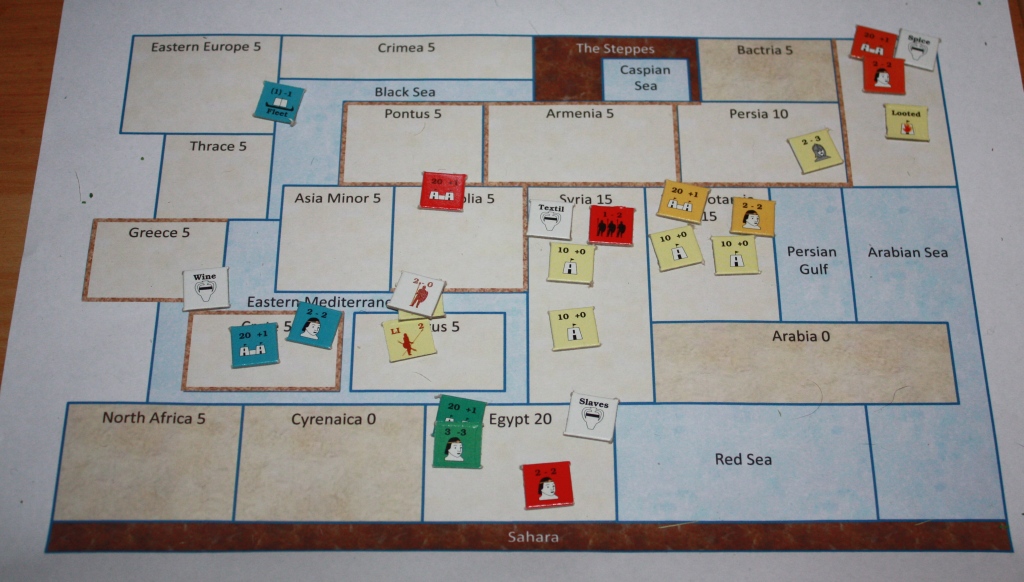 |
| End of Summer 1702BC |
Hittites remove UNREST.
Non-players turn
None.
Babylon turn
Does nothing
Hyskos turn
Does nothing.
Hittite turn
Sieges Avaris
Siege of Avaris Fall 1702BC
Hittites: 23CP
Hyskos: 12CP
Hittites lose 1CH 1LA
Hyskos loses 1CH 1LI
Hittites continue.
Hittites: 19CP
Hyskos: 6CP
Minoan turn
Minoans do nothing
Indian turn
Indians move into Armenia.
Battle of Armenia Fall 1702BC
India (attacker) 17CP : 5LI 3MM 1LA Charges
Armenia 8CP: 3LI 2 LA refuses flank
The Armenians manage to inflict a lot of disorders, and being on the hill helped. but the centre LI was destroyed and so were the two skirmishers, leading the army to panic and they were cleaned up while routing.
Non-players turn
None.
Babylon turn
Does nothing
Hyskos turn
Does nothing.
Hittite turn
Sieges Avaris
Siege of Avaris Fall 1702BC
Hittites: 23CP
Hyskos: 12CP
Hittites lose 1CH 1LA
Hyskos loses 1CH 1LI
Hittites continue.
Hittites: 19CP
Hyskos: 6CP
Ouch, Hittites only lose an LA, while Hyskos loses all units.
The Hittites enter Avaris victorious Hyskos is out of the game.
Minoan turn
Minoans do nothing
Indian turn
Indians move into Armenia.
Battle of Armenia Fall 1702BC
India (attacker) 17CP : 5LI 3MM 1LA Charges
Armenia 8CP: 3LI 2 LA refuses flank
 |
| Armenians at the top with some rough ground and a hill; Indians at the bottom. |
 |
| Deployment |
 |
| End game - the unlucky Armenians lost an LI in the centre to bad die rolls. |
 |
| End of Fall 1702BC |
Winter 1703BC
Time to pay for upkeep
Non-players turn
None.
Babylon turn
Does nothing, no treasury
Hittite turn
Does nothing, no treasury
Minoan turn
Does nothing, very little treasury.
Tempted to invade Anatolia to take the Hittite capital city, but I think the retribution would be too much.
Indian turn
Moves forces in Armenia back to Persia
Spring 1703BC (last turn)
Time to pay for upkeep
- Babylon manages to keep 1CH 2LI 1LA
- Hittites keep 2CH 2LI 2LA
- Minos hangs on to 1CH 1LI 1LA and even has some talents left over.
- India loses 4LI and keeps 1LI 3MM 1LA
Non-players turn
None.
Babylon turn
Does nothing, no treasury
Hittite turn
Does nothing, no treasury
Minoan turn
Does nothing, very little treasury.
Tempted to invade Anatolia to take the Hittite capital city, but I think the retribution would be too much.
Indian turn
Moves forces in Armenia back to Persia
 |
| End of Winter 1702BC |
Woo-hoo! income:
Babylon: +55
Hittite: +100
Minos: +25
India: +45
This turn will be a scramble to get some victory points so as not to fall to far behind. I am also going to call this the last seasonal turn, so let us see how far the major countries can get
Non-players turn
None.
Babylon turn
Buys two research but gets nothing :-(
Hittite turn
Buys Religion (costs 100, gives 150 victory points)
Minoan turn
Buys one research and gets MEDICAL.
Indian turn
Founds the city in India as built previously.
End Game
Victory points are treasury, income and things acquired such as Technology, religion etc. and subtract for things like enemies at court. Final scores:
Babylon: 111
Hyskos: 150
Hittite: 250
Minos: -18
India: 116
Hittite is the winner!
Hyskos came second - even though they were destroyed, they had discovered Law (100) and Medical (50).
Verdict
Where to start? Summary: underrated, very random, finicky, great for generating battles, loads of fun.
This is quite an underrated game, but it is not for everyone. It is not too historical but has a historical feel. It would work just as well using the tables in the rules to play out the battles, rather than using a battlefield. The later scenarios are a lot more differentiated compared to this one and the major countries (players) are more spread out.
It is quite random in where raiders can come from, and what can happen when you try and govern. The events can be really good, really bad or nothing much. i can imagine being a player and a few bad events in a row would make this game no fun at all, and there is not much to balance out poor events other than randomly getting some good ones. Which brings us to the finicky bit. You do need to track your units, of which a player will have anywhere from 5-20. So it is operational with a bit of detail here. A player needs to keep track of treasury and discoveries, and work out income and expenses. There is a player aid chart but it is still stuff to keep track. My spreadsheet really helped out here. The unit counters are a bit sparse for the players as most are generic e.g. you build a new city - there are no counters for more players cities besides the capital so it needs to be a generic one and then somehow keep track of it. It would be nice to have tracking counters for each country.
Where it shines is the battles - regardless of what rules you use this is great for generating mismatched battles. You do need rules for what happens if one side of overwhelmingly outnumbered but other that that, you could use rules of choice and go with what makes sense converting the units. You could multiply the number of Imperator units by a factor to increase them for a tabletop battle,and divide them again after the battle to convert them back. This is where I think the game really shines - it is a n operational game but battles play an important part and can easily be done outside of Imperator. My rules worked really well and I need to tidy them up a little, play a test game on 12x12 grid and then I will then put them up on this blog.
Most importantly, it was loads of fun! It makes me want to play some more of the scenarios (there are about 14). I had a great time - 12 battles, got to use the 6mm figures, wrote some new rules, completed a project started 20 years ago and the game threw up surprises all the time. I could not ask for more.
Babylon: +55
Hittite: +100
Minos: +25
India: +45
This turn will be a scramble to get some victory points so as not to fall to far behind. I am also going to call this the last seasonal turn, so let us see how far the major countries can get
Non-players turn
None.
Babylon turn
Buys two research but gets nothing :-(
Hittite turn
Buys Religion (costs 100, gives 150 victory points)
Minoan turn
Buys one research and gets MEDICAL.
Indian turn
Founds the city in India as built previously.
 |
| End of Spring 1703 and end of game. |
Victory points are treasury, income and things acquired such as Technology, religion etc. and subtract for things like enemies at court. Final scores:
Babylon: 111
Hyskos: 150
Hittite: 250
Minos: -18
India: 116
Hyskos came second - even though they were destroyed, they had discovered Law (100) and Medical (50).
Verdict
Where to start? Summary: underrated, very random, finicky, great for generating battles, loads of fun.
This is quite an underrated game, but it is not for everyone. It is not too historical but has a historical feel. It would work just as well using the tables in the rules to play out the battles, rather than using a battlefield. The later scenarios are a lot more differentiated compared to this one and the major countries (players) are more spread out.
It is quite random in where raiders can come from, and what can happen when you try and govern. The events can be really good, really bad or nothing much. i can imagine being a player and a few bad events in a row would make this game no fun at all, and there is not much to balance out poor events other than randomly getting some good ones. Which brings us to the finicky bit. You do need to track your units, of which a player will have anywhere from 5-20. So it is operational with a bit of detail here. A player needs to keep track of treasury and discoveries, and work out income and expenses. There is a player aid chart but it is still stuff to keep track. My spreadsheet really helped out here. The unit counters are a bit sparse for the players as most are generic e.g. you build a new city - there are no counters for more players cities besides the capital so it needs to be a generic one and then somehow keep track of it. It would be nice to have tracking counters for each country.
Where it shines is the battles - regardless of what rules you use this is great for generating mismatched battles. You do need rules for what happens if one side of overwhelmingly outnumbered but other that that, you could use rules of choice and go with what makes sense converting the units. You could multiply the number of Imperator units by a factor to increase them for a tabletop battle,and divide them again after the battle to convert them back. This is where I think the game really shines - it is a n operational game but battles play an important part and can easily be done outside of Imperator. My rules worked really well and I need to tidy them up a little, play a test game on 12x12 grid and then I will then put them up on this blog.
Most importantly, it was loads of fun! It makes me want to play some more of the scenarios (there are about 14). I had a great time - 12 battles, got to use the 6mm figures, wrote some new rules, completed a project started 20 years ago and the game threw up surprises all the time. I could not ask for more.


.jpg)


