Showing posts with label children game. Show all posts

Saturday, 20 August 2016

WW2 West Front 1944 20mm game with the children

Introduction
My 7 yo son has asked to get out my 20mm WW2 toy soldiers and play a game.  He has been asking for the last 5 months but weekend events seemed to conspire to never have enough time to setup and play.  Recently the rest of the family was away for a few nights and I got in some solo 20mm on half a table tennis table.  When they came back, I had packed it up but left it upstairs (not packed away downstairs with other stuff) on the assumption I would get a game in.  Well it all came together; and as a bonus, my oldest daughter (9) was also keen to play.  I got Zombicide earlier this year (long story as I have zero interest in zombies) and have played a few games with my son who I have never seen soooo excited as playing Zombicide.  Zombicide is a co-op game (players are all on the same side against the system).  So I had determined that if I played WW2 20mm it would be co-op.  My solo skirmish game is a d6  version of NUTS! so would be ideal.  I streamlined it is a lot, and very early in the game I streamlined it even more!

Rules
So I had some quite simple rules where you roll to hit, then determine if the hit target was suppressed or KO.  It got hard with the first dice hitting the table.  So changed it quickly to a hit caused the figure to be removed from the table.  And instead of rolling for a reaction individually, just rolled one die for the entire unit that either did nothing, fired back or was suppressed (really easy 1-2 fired back, 3-4 nothing, 5-6 suppressed and retreat).  The chance to hit was simple -  5+, +1 if firer did not move, -1 if target in cover - this was not that simple in reality!  So I just told them what the hit chance was.  4+ but 5+ if you moved, and 6+ if they were in cover.  Close combat was each figure rolls a d6 with 4+ a hit, +1 if in cover, +1 if charging.  Compare hits – winner loses 1 figure, loser loses the difference (up to 3) and retreats. I think that was just about it for the rules.  We were the British and they picked Churchills.  As they are slow, everything moved at 6", 12 inches if you ran (could not fire).  I think that was about it for the rules, Oh, hang on, there was a penetration test when a vehicle was hit.  And there were actually spotting rules – firing and moving units could be seen at any distance, infantry not moving/firing and in cover was 12”. 

Activation was card based - I had one red card for each of our forces and one black card for three unknown German forces.   Card matched their age so there was a 7 and a 9.  when I asked what my card should be, they both simultaneously said "A King!".  I have trained *cough* brainwashed *cough* them well :-)

If you want to know where I am with what rules to use next time, then go to the end as I do discuss future rules a bit more in the Verdict section.

Troops
We were the British. Scale of the game (not that I told the children) was 1 figure is 3 soldiers and distance scale of about 1:300  I gave each of them 10 soldiers, 1 Vickers MMG team, 1 PIAT team and 2 tanks.  My son really wanted some of the German tanks as they looked "awesome".  Or Russians – he picked out a KV-1 and said this must have been a difficult tank to kill.   He did not want Shermans either.  The Churchills were OK by his standard, so we went with them.  I was the Commander with 3 other in HQ and a mortar section.  I did not take much so I could help out running the game.

Son's 7 Platoon on the lest, Company HQ (me) at the top right 

Daughter's 9 Platoon

Table
We setup the table, which they found loads of fun.  I put a hill down, and then I said time to put down some roads and they went wild.  And then I mentioned to put a few houses down, but ended up using lots!  The woods were then put down and ready to go.  

The table - British to enter from the bottom
We picked out 6 objects (jerry cans, animals etc) to represent to unknown German forces.  I got them to place them where they thought would be the best place to be if you were defending the village.

unknown force location and indicative movement directions for the units.  S Platoon should be 7 Platoon, N Platoon is 9 Platoon.
For each of the unknown forces when it was to be discovered I used a roll of
   1-2: nothing
   3-4: 5 enemy soldiers
   5-6: 2-3 tanks, or 5 figures and a tank

My daughter insists on a photo.  We played in the morning and so we ended up not changing out of our pajamas until after the game had finished!  Behind her is the infamous map drawers from where inside I play all my 2'x2' games.

Deployment
The children setup near the entry edge however they liked.  Each had to make sure that one figure was the commander.  They did like having some troops riding on the tanks so there are a few pictures with infantry riding high on the tanks. The objective was to take the town and so we had a quick planning meeting – 9th Platoon to head up the road and clear the woods and right side of the village, 7th Platoon to take the village straight on via the left flank. I would travel with 7th Platoon.

The Game
I took no notes and only took some pictures but will do my best to recreate the narrative.

7th Platoon head out, leaving some behind as a reserve and the Churchills and some soldiers up to the hedge in front.  Measured to the enemy marker – 12”! so we rolled to see what it was – a 6.  I get my son to put out three Stug IIIs.  We rolled to see who go to fire first.  The Germans.  Three rolls and all misses (a 5+ required).  The Churchills fire back and destroy a Stug!  My son (7th Platoon) did manage to roll what seemed like a lot of 6s in the game.  Unlike my daughter with 9th Platoon that had a lot more 1s….

7 Platoon engages with some Stug IIIs.
9th Platoon heads up the road and into the woods.  The unknown force there turns out to be five Germans. Five soldiers of 9th Platoon charge them, but with unlucky rolls sees 3 of 9th Platoon dead and the rest retreat.  But one of the Churchills moves into the woods and kills a few of the Germans and the rest retreat.

Churchill enters the woods to take care of the Germans that killed some of her soldiers.
The 9th Platoon MMG that retreated is unsuppressed and fires at the Germans for no effect – 3 1s.

The 7th Platoon get within 12” of the large house.  It is 5 soldiers.  9th Platoon decides to fire at it with the tanks but only one soldier destroyed.  The Germans fire back and kill off some more of 9th Platoon.  But with combined fire form the Churchills and 9th Platoon, and a little help from a few soldiers of 7th Platoon, the house is captured!

9 Platoon advancing on the right building that turns out to be 5 Germans.
I assault the last Stug with 3 soldiers.  I make up the rule that they each roll 1d6 and on a 6 the tank is destroyed, else 1 soldier is killed and the retreat. I managed to roll a 6 and the last Stug is destroyed.

The Company HQ (without the Captain) assaulting a Stug.

With the last Stug gone, 7th Platoon is still mostly intact and advances forwards with the infantry and a Churchill in support.  7th Platoon managed to clear out the house eventually, losing more soldiers and also the MMG was suppressed and failed to rally.  Leaving the MMG, 9th Platoon (or what is left of it) advances to assist 7th Platoon to assault the read of the village. Note that the unknown enemy force in the burnt out ruin on the edge of the village turned out to be nothing, This leaves the two unknown forces at the rear of the village to clear.

Action shot of my son moving his 7 Platoon forwards (the ruler is from the NZ War Museum from when we did a trip to NZ  last year).

9 Platoon Lieutenant riding the Churchill and leading the remnants of his infantry platoon to help 7 Platoon. 

7th Platoon gets within 12" of one of the rearmost building.  It turned out to be 5 figures and a tank, so I put out the last of my late War Stugs.  just to add an element of danger, I also added in a Panzerschreck team - both the 7th and 9th Platoon still had both their tanks). Shocking rolls by the Germans saw them miss, and the 7th Platoon tanks roll well and brew it up.

The rearmost building - 5 figures, AT team and  a Stug, the latter already knocked out by a Churchill. The smoke on the building is simply smoke coming \out of the chimney that my children put there at the start of the game.  The cow at the rear is the other, and last,  unknown enemy force.
My son fired at the house with the Churchill for no damage, so he charged in with all the infantry he had.  The opposed die roll was about equal and the score was a tie!  One loss each and the melee will continue next run.

the 7 Platoon charges into close combat with teh house, a soldier lost on both sides, and melee conttinues.
Meanwhile, 9th Platoon that was advancing up the centre road also gets within 12" of the last unknown force.  a roll of a 6 sees it being 2 tanks.  I put out two mortars and just to make it a little harder, put out some infantry as well.  While I was getting the Marders out, my some saw an AT gun and said that should go out too!  So out it went right at the rear of the table - it doesn't appear in any of the shots.

The Marders open fire on the advancing 9th Platoon Churchill and knock it out with a lucky penetration roll.  Out first armour loss.

Right next to the previous building (which would be off to the bottom of this picture) the last remaining unknown force it revealed to be Marders and more infantry.
9th Platoon brought up their remaining soldiers (some went the long way around via the wheatfield at the rear) and the remaining Churchill.  Under a combined effort of firing they managed to destroy the soldiers defending the house.
9th Platoon sent three soldiers to try and attack a Marder that was successful (still made it only a 5-6).   They then went on to attack and destroy the crew of the AT gun. The other Marder destroys one of 7th Platoon Churchills. Two armour down.  Luckily, the Churchill manage to destroy the last remaining Marder.

3 soldiers of the 9 platoon assault a Marder (successfully)
Another melee at the other house and another tie!  Three soldiers of the Company HQ have finally arrived and join in. Another another melee and a decisive melee win.  The last of the German defenders run away to fight again another day.

Success at the house.  
We won!

A shot at end game - the two destroyed Churchills can bbe seen, and almost all the British infantry left is in this picture.

But what about the Captain of the Company? The commander setup shop on the top floor of the left flank house.  From there he had a wide view of the table to call in the mortars.  I ruled it would be a 3+ to call them in  So for the next 5 turns of the game I continued to roll 1 and 2s!

..and the PIATS? The PIAT team of 7th Platoon did manage to squeeze a few shots off at some enemy tanks, but missed every time.  The 9th Platoon PIAT team was lost midway during the game as casualties to enemy fire.

Verdict
They had fun. They want to play again. So those two things indicate success.  And I had fun too.  Three successes!  I did not help them out at all, except to tell them whether it was a 4,5, or 6 to hit, and by the end of it they were getting better at knowing 6s were always good!  I think I need to go for more dice or less modifiers.  I have come to realise that my children do so much better with adding and removing dice than with dice modifiers.  e.g. 5, 6 on a d6 is a hit -  roll 2 dice to hit, 1 dice if in cover.  I have been adding and subtracting modifiers to d6s for 35 years and it comes automatically to me - I just know what 4+2-1 is without even working it out any more.  Not so my children. Although I still do want to play One Hour Wargames again with my daughter - it does have addition/subtraction but there are not so many dice rolls, and so she would have time to think it though.  WW2 with 30 figures is a different story.  We have played WarHammer Quest for many years now with modified combat rules where a 5,6 are hits and you roll x dice to hit.  The target rolls x dice for saves (a save ona 5 or 6).  So they are quite familiar with adding and subtracting dice to a dice pool.  I don't really like buckets of dice - anything up to 5 regularly would be fine and more at the odd time is OK.  I also played the Arkham Horror boardgame that also simply adds and subtracts dice from a pool.  I can see the attraction of this now, after 35 years of having a preference for single d6 with modifiers.

Anyway, the next rules I use will be something that adds and removes dice.  I have been looking to play Nordic Weasel's 5Core skirmish for ages and this will be perfect.  So the next game with them will be that.  The 3rd edition is out (wow - has it been that long since it first came out).  I think I will use that over 5 Men in Normandy or 5 Men at Kursk (although I think I will use the activation mechanism from Kursk).  5Core is a tight well defined game and I can then reuse it for sci-fi games.  Kursk has more rules (range etc) and Normandy is not as Streamlined.  They are all good rules and you need to buy all of them!

Lastly...

But here is the strangest thing.  They want to play on a smaller table, and when I say smaller, I mean *much* smaller.  As in 3’x2’. Over the last three years, we have got out my 3’x2’ board about 3 times to play with the toy soldiers.  Not really gaming, just setting them up and pushing them around.  They all agreed that the bigger 4.5’x5’ table was just too big.  I was not expecting that.  We had a discussion and they decided that about 5 figures and 1 tank each should be fine on a 3’x2’ table.  We can still play the same rules – I play with the same movement rates when I play on a 2’x2’ with a section/squad, so 3’x2’ will be fine.  5core will be perfect for this size table and with 5 men and a tank each.  Not sure when the next game will be – we have a busy few weekends ahead.  And my daughter has also started pestering me to play ancients with Neil Thomas’s One Hour Wargaming with horses - I mean cavalry - again.

Wednesday, 26 November 2014

Ancient Game with 8 yo daughter and One Hour Wargames

Introduction
I bought Neil Thomas's One Hour Wargames as soon as it came out and devoured it in a single setting.  Nice simple rules, easily modified.  It comes with 30 scenarios, which is great value in itself and I had visions of playing the scenarios with other rules, or at least using a heavily modified version.  That was September 2014 and I put them aside.


Links of use
Here are some links to reviews/replays using these rules:
Heretical Gaming blog post review
El Rincón de Slorm blog post review
KEITH'S WARGAMING BLOG blog post review
John’s Wargame Page blog post review
Wargames Illustrated review
Cambronne's Reply blog post review
SPEAR TO THE STRIFE blog post review
Yahoo groups for discussion on Neil Thomas's rules

You can buy it via Amazon, Pen and Sword, On Military Matters and likely others.

Introduction (continued)
Fast forward to a few days ago (November 2014) and my eight year old daughter says "when are we going to play with your ancient figures - the ones in the drawer?"  I have a set of map drawers and there is always a few ancient games set up on 2'x2' boards inside. We used to occasionally get one out and push some figures around.  No rules to speak of - just line them up in pretty rows.

My daughter struggles with maths and I have been doing extra addition and subtraction (with numbers under 20) for the last couple of months, usually using online maths games, verbally or the abacus.  As soon as she said ancients game I thought of Neil Thomas's rules - it has adding or subtracting 2 from a die roll (damage inflicted), and adding numbers to 15 (15 is the "hit points" of a unit).  So today, we set up a table a played a game.

Plans and children do not mix, but this went brilliantly.  So brilliantly and so rarely, I felt the need to write a blog post!

The Setup
It was a going to be a quick game.  I had some medieval figures in a box I had ready for another game that never happened. My daughter loves horses and you get a lot in the medieval part of the rules.   I played with just one WRG DBx base is a unit and used a 30cmx30cm cork tile I had from years ago. Distances would be measured in cm.  And we would use a roster off the board to score the hits (as part of the aim of the game to add up the hits!).  I cut two pieces of timber - 6cm and 12cm - to be the movement and archery range measuring sticks.  I would go for 5cm and 10cm next time and this fits in with the 30cmx30cm table.  Rules are originally designed for 36"x36" with 12" long moves; this would convert on a 30cmx30cm board to 10cm long moves, not 12.

The scenario would be a simple flat table, no terrain.  We rolled for the units. The rules have a simple system to roll a single d6 per side for random forces.  I setup first and let my daughter set up after seeing my setup.  I did not help her with her deployment but she copied mine to an extent.  She has never played a game of miniatures with rules before so she does not have a grasp of tactics and occasionally I explained possible options for her to choose from.

My daughters forces, mostly Romanian Franks

My forces, random medieval. Note that I only have two figures on my archer base, but this is just to easily differentiate them from the other side.
I explained the rules.  Took about 10 minutes.  She did say after the game this was the only boring bit.

For those that are interested, here is a summary of the medieval rules:

  • Alternate turns and each player turn is move, shoot, melee.  Cannot move and shoot.
  • Mounted move 12, Infantry 6, archers range is 12.
  • For shooting, select a target and roll 1d6+2.  This is the damage inflicted on the target.
  • For melee, roll 1d6 (+2 for Knights, -2 for Archers) for damage to the target.
  • Men-At-Arms halve damage received due to their armour. Flanks attacks double the damage.
  • A unit is eliminated when is reaches or exceeds 15 hits.
  • Game ends when one side is eliminated.
Game start - I am at the bottom, Daughter at the top.
The Game
My daughter went first and promptly moved her Knights to within a few centimetres of mine.  This meant I would charge next turn and get in damage first.  But she did not care!  I helped her with moving the archers (i.e. don't move them to where I can charge them).

My daughter's first move.  A normal knights tactic!
I charged in and so get to inflict damage first on each of her three knights.  This gave her the opportunity to draw a small icon (her idea) to represent each unit and write down the its damage.  We were using rosters so she could add up damage as it occurred, part of the point of the game.  I did not move my Levies into the Men at arms on my right flank as they are take only half damage.  My Knights should win, and then help take them out. This plan sort of worked. 

Note: I pivoted my archers and then fired.  I should not have been allowed to fire.  I realised my mistake later and gave my daughter a bonus move later on.

I charged the few centimetres in response.
I did think about moving some infantry onto the flanks of her knights, but thought that maybe I should go for the archers on either flank instead. Not sure if this was a wise choice or not.

On the left, I charge my Levies into the Archers. My Levies had already taken 13 points of damage from good archery fire, so I needed to at least damage the Archers to regain some honour. On the right the archers move to get into a position to fire on my daughter's Archers.

I moved to destroy the flanks.
The combat between the Knights goes roughly as expected - My daughter loses two Knights when they reach their limit.  The next turn, I lose a Knight.  But I also lose a Levies. The Men-at-Arms absorbing 1/2 damage is quite good, especially as I was rolling 1s and 2s!

My daughter loses two Knights, then next turn I lose one Knight and the right flank Levies. 
My daughter is not upset by this at all!  She is having too much fun!
My daughter's last Knight goes the turn after so I charge the right hand archers with some Knights.  I forgot to move my other Knights (what was I thinking - I have no idea).  I allow my daughter to pivot 180 and charge my Archers to balance against me firing on the Men-at-Arms when I should not have  (normally you can only pivot 45 degrees when charging).

Knights charge the archers (top right); Men-at-arms charge my Archers (bottom right)
As expected, my Levies fail against my daughter's Archers on my left flank.  Although she had some bad rolls, and Archers subtract two from the die roll, I was only 2 points away from elimination when I charged.  I charge the Knights I forgot to move last turn into the Archers.  Victory for both of us on my right flank.  Her Archers gone, as are mine.

My Levies gone and charged with the Knights, on the right we both lose an archer unit.
The Men-at-Arms charge into the rear of my Knights.  Double damage for a rear attack.  I have 10 points, she rolls a 4.  She added the 4 to 10 damage the Knights were carrying, and then was very excited when I said it was double damage for a rear attack!

The Men-at-arms, after routing my Knights on the right, move to attack my Knights on the left.
Her Archers were never going to last very long against my Knights.  But my Knights know have a total of 14 damage form all the melees so far.  And the Men-At-Arms charge in the flank for double damage.  And roll a 6.  My daughter is excited once again.  She does not add it up: 14+12 is obviously more than 15.   Her Men-At-Arms are the last unit standing. A close game.  She has won!

The last melee.  It ended as bad.

The last unit on the table.  My daughter's Men-At-Arms.
My daughter could not resist writing out her win.  And put her winning army on display around it. And forced me to take a picture.

My daughter ensures we all know who won against whom.

A well deserved win to my daughter.  My first game with actual rules against her.

Verdict
It took about 40 minutes to play.  Without much tactics - just getting in - that seemed reasonable playing time.  I had fun, and there is lots of adding and a bit of subtraction, which was the aim of it after all!  Having to halve some hits and double flank attacks was a bonus for the maths too.
After the game I asked her what she thought.  Her answer "That was awesome!"  makes me think we will be playing again!

Oh, and the rules.  I like them.  And without any modifications!

Sunday, 17 August 2014

Warhammer Quest (simplified) with my children

Introduction
I mentioned on some forum that I occasionally played Warhammer Quest with my children.  The response was that I should post a report of one of the game, just to show how it goes.
The box

Background

The game
My best friend gave me the option of getting a lot of his games when he moved interstate about 4 years ago.  One of those games was Warhammer Quest. I put it away but about two years ago, I thought it would be fun to get out and just push around some figures on the tiles with my children (at that time 3 and 5 years old).  We pushed them around and had fun.  Late last year, I dragged it out again and actually skimmed the rules this time (I had played it once in the 90's I think, possibly I have never played it) and put something together.  Lots of fun.

Heroscape
Early this year I found Heroscape in a charity store going cheap and just had to buy it, although I had never heard of it.  Glanced at the rules and played my own version of it (very simple!) with the children a few times.  The reason I mention Heroscape is the combat system: Heroscape combat uses d6s with two blank face, two faces with red skulls and two faces with blue shields. the attacker rolls a certain number of dice and it looking for skulls, the defender also rolls some dice and it looking for shields.  compare skulls to shields for a result.  While this could be implemented just as easily with normal d6's and just look for 5s and 6s, my children caught onto this straight away,unlike using dice.  although, naturally they are good at reading dice - but comparing dice...easy.

Putting it together
So we have played about 3 games of Warhammer Quest in the last 6 months. My children are 7.5 and nearly 6.  Applying the Heorscape combat system has made it great.  I can vary the length of the game by the number of passageway cards and the numbe rof monsters that appear.  The game I am posting is one that they asked about playing after about a month had gone past since the one previous.

The simple rules
If you know the rules to Warhammer Quest you will recognise some of the rules below. I write them down only to serve an example of what I have done! Note I have still only skimmed the rules.  Once. About 2 years ago.  I do make stuff up on the spot but that is rare. The rules I write below I keep in my head - I need no charts, QRSs etc.  I have never had to refer to the rules, only as that will slow the game down!  I don't use the character sheets. Why?  Because I want a game that will take less than a hour.  That is about the amount of time I have at night to play a game with them. Some of the stuff in on the cards, which makes it easy. I do look up the adventure book.  I do expect as they get older I will actually read the rules and play them!

Shaun's simple WQ rules (skip if don't care)
Note these rules are for 3 players.  Normally I am the barbarian, my son is the Wizard or the dwarf and my daughter is the elf or the Wizard. I end up the Barbarian every time. They take turns each game being the Wizard as the Wizard gets to roll a die at the start of each turn.

One of them picks the end board.  I then randomly pick 3-6 dungeon cards (3 for a short game, 6 for one hour).  I do not use the T sections (no splits).  I make sure there are 2-3 rooms and 2-3 passageways.  The end board dungeon card goes on the bottom.
The actual game has a really nifty system for T intersections and ensuring you never know when the end board appears. The children do not count cards and so do not care.

Starting the game - draw the first dungeon card and place the characters on it.

Game turn
Wizard rolls the die.  A 1 indicates a random event so draw a card and perform the event.  Remember the other number - that is the Wizards spell points.
If no event, everyone can move about 6 spaces. Whatever is required to get to the next door.
Draw an event card when you enter a new room (not a passageway).
That's it.

Events 
Events are normally monsters (but not always).
I fudge the amount of monsters as there are only 3 characters, but it is about 2/3rds of what is on the card. Normally the characters get to attack first. Monsters will fire bows if they have them, or move to fight a character if no bows.  Each monster will pick on only one character and just keep attacking them.  Monsters will also distribute themselves fairly evenly against the characters.  If there are both strong and weak monsters, the weaker pick on the Wizard, while stronger monsters pick on the Dwarf/Elf/Barbarian.  They don't gang up on one character.  And characters generally cannot move if attacked - they have to keep attacking the monster attacking them.

The events that are not monsters, such as poison gas, I convert that into something that works with the combat rules.

Draw a treasure card after every event.

Combat
Combat happens first for all the characters who have an attack, then all the monsters have an attack.

Each figure has attack dice and defense dice and hit points.
Dice are Heroscape dice with 2 skulls, 2 shields and 2 blanks.

The attacker rolls their number of attack dice and counts skulls.
The defender roll their number of defense dice and counts shields.
If more skulls than shields, the defender takes that many hits.

If a monster reaches their hit points, they are dead.  If a character reaches their hit points they are unconscious, but if they exceed their hit points they are dead.


Character Stats
Elf and Barbarian have 4 attack dice and 4 defense dice and 4 hit points.  The elf also has a bow that fires with 2 attack dice.
Dwarf has 4 attack dice and 5 defense dice and 5 hit points.
Wizard has 2 attack dice and 3 defense dice and 4 hit points.  The wizard also has, once a turn, a fireball spell of 4 attack dice.  And it also gets a number of attack dice to use based on the roll of the dice at the beginning of the turn, unless a 1 was rolled.  These attack dice can be used once or added to any attack or attacks, including the fireball spell.
Note the barbarian comes out fairly poor in comparison to the rest.  I think I will be going with 5 attack dice next game, just to make hum a little different.

Monster Stats
Minotaurs (my son's favourite's) are 4 attack, 4 defense and 4 hit points.  They are tough!
Orcs are 3 attack, 3 defense and 3 hit points
Skaven are 3 attack, 2 defense and 2 hit points
Goblins are 2 attack, 2 defense and 1 hit points
Snotlings are 1 attack, 1 defense and 1 hit point
Bats get to attack first and are like Snotlings

Healing
The Elf has the healing potion.  Each turn (unless an event is rolled) each injured character can roll 3 dice and the number of shields is the number of hit points received. If they are unconscious, restoring hit points will allow them to wake up.

The Game

Note: we play on the carpet on the floor.  For some reason, we play all our games sitting on the floor.

And before you ask, Sacha is a boy (he is the one nearly 6).

The early game
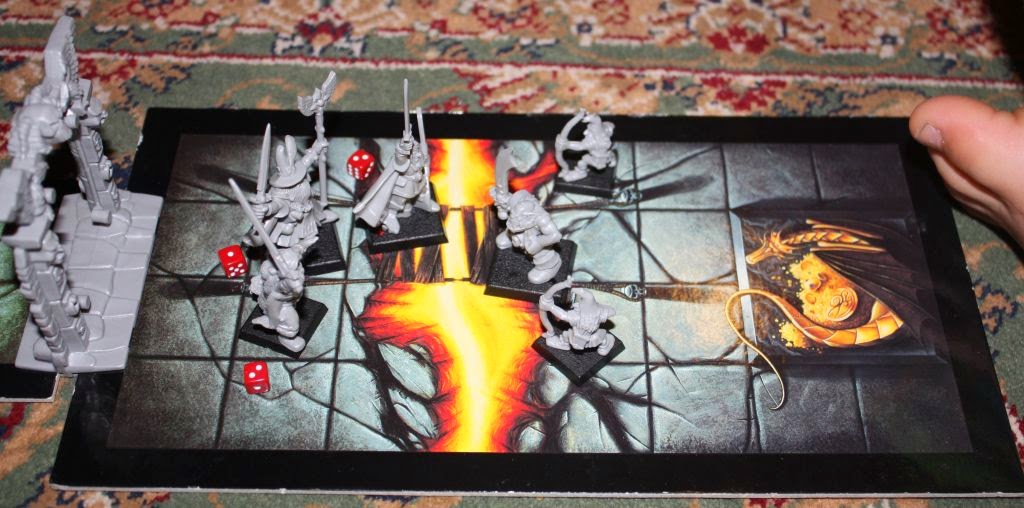
The Wizard, the elf and the Barbarian ready to enter the dungeon. 
First tile is an empty passageway.
The next room see some bats appear.  But they are easily dispatched (note this is not always the case but this time, it was all over in two combat rounds). 
The treasure found in the bat room was the Chalice of Fate.  Wizard Nadia saved this to near the end. See later for details.  
A '1' is rolled meaning an event.  3 orcs!
Sacha the Flf roll brilliantly - this is just one example.  4 dice and 4 hits.  I think 2 orcs were dispatched by Sacha the Elf alone!  
The party continue on down some stairs.

The dwarf, the dead body and the Minotaur

The next room has a dying dwarf in it.  We go over for a chat and he gives us the key to the portcullis. This is only useful if you get the portcullis event, which we did not. 
..but we did find a treasure.  And a good one too.  To convert into my rules, Sacha the Elf can roll 1 extra die (3 dice rather than 2) when firing his bow.  This was used to great effect for the rest of the game. 
Another passageway.  Boring. 
And another passageway. Boring.  unless you roll a 1 for an event and get...
..a dead body  that I take the bag from and roll a 1 - Poison Gas!
We take a few hits each...
Just in time for a minotaur to show up (another 1 roll at the start of the turn).  Wizard Nadia was tempted to re-roll this event, but held off.
Sacha the Elf fires his bow (at top) for a great result.  The Minotaur defends (at the bottom) for an even better result.  I was starting to panic a little at this moment. 
The three of us ran up to the Minotaur, who managed to swing his axe and miss, and each had a go with great dice, and his dice were poor beyond belief. Obviously he had used up all his good defense dice on the first arrow.  Sacha the Elf heals us all with no unexpected events interrupting us.

The Chasm!
We arrive at the final room - the bridge over the fire chasm.  Defending the room are two minotaurs, 2 goblin archers and 2 orcs.  We have to eliminate them all, and also destroy the bridge.
Things are not going so well.  The goblin archers do some damage to the wizard and the Elf.  I do manage to put a few hits on a minotaur.
Wizard Nadia's  fireball takes out the minotaur.  4 dice, and another 5 from the wizard spell roll. Sacha the elf takes out one of the archers. 
Despite me calling out not to move on the bridge, Sacha the Elf''s blood is up and he advances onto the bridge.  Now he faces the minotaur alone and no one can help him.  He defeats the minotaur with ease, taking two hits in the process.  The minotaur falls off the bridge into the lava below.  Sacha the Elf likes that, especially as one of his favourite things in Minecraft is lava!  
The Goblin archers shoot me for a few hits and I am down and unconscious.  Not to worry though, Sacha the Elf has dice that can do no wrong and dispatches a blocking orc while taking only 1 hit.  Another monster falls into the lava!  The Wizard and the Elf take out those pesky archers!
For those making it this far, Wizard Nadia very early on had the chalice of fate allowing a re-roll once.  Wizard Nadia had been saving it for when things were really bad. Very handy right now as we are all very wounded and she rolled a 1 for the start of the turn.  This would normally mean an event - and with the Barbarian unconscious and the Elf with only 1 hit left.  She re-rolled to something else. Whew.  
We all get healed and hack at the bridge until is is destroyed.  We gloat over the amount of treasure in the room.
A shot of the whole dungeon.
Verdict
This gamer took about 10 minutes to set up and just under one hour to play after that.  The last 10 minutes was over their normal bedtime but we were at the Chasm - no way were we going to stop.

Post script: Heroscape
The Heroscape box is out, and we have played it before.  So, a few days later, my son and I play about 3 games over an hour.  It is not Heroscape - it may look like it but we just run around the battle board trying to get counters and fighting over them.  It works really well.

A small Heroscape battle setup. Normally we play on something larger.   Combat is a light version of the Heroscape rules and works a bit similar to the Warhammer Quest combat I use and is described earlier.